


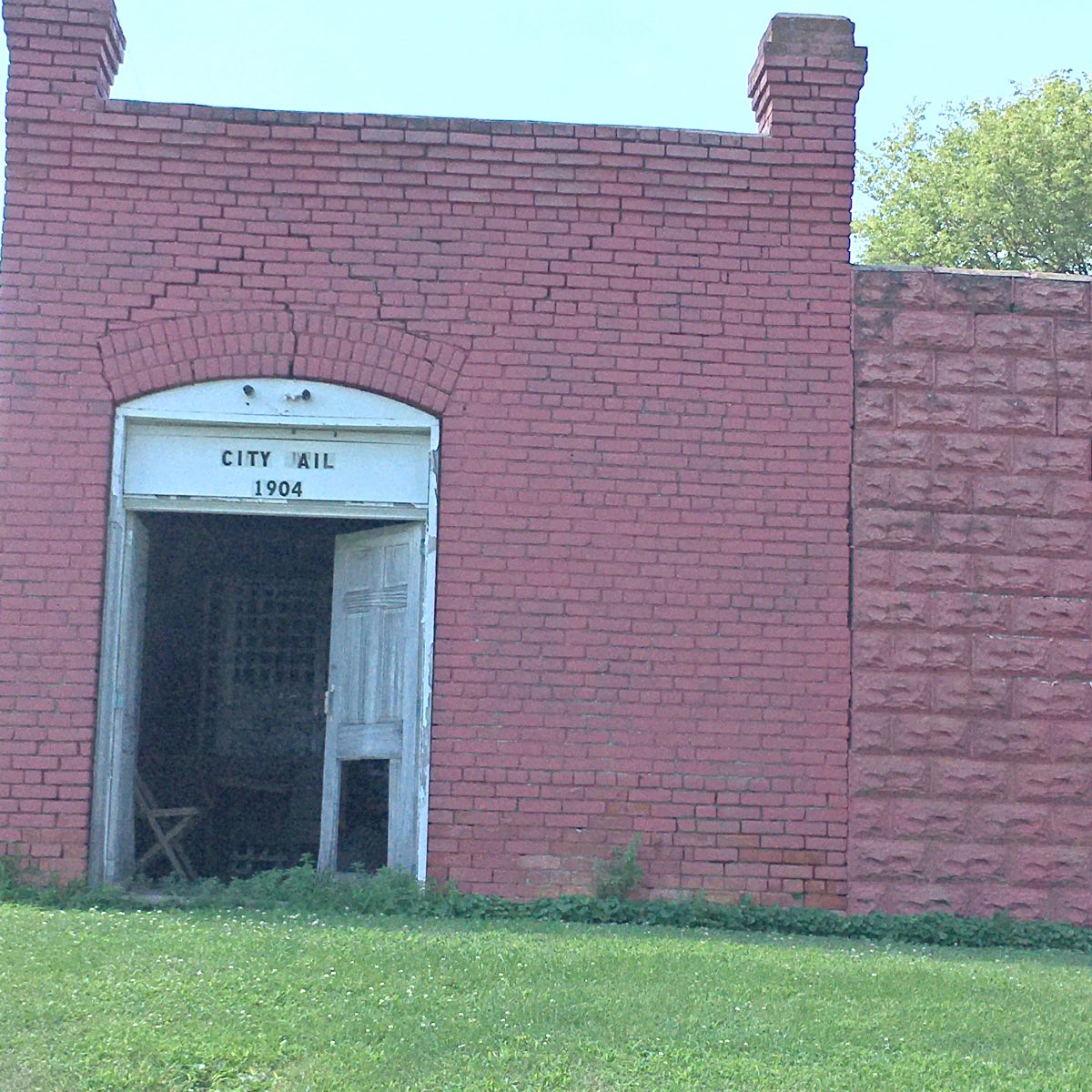
On September 19, 2020, Brownfield Bros. took the Blanchard jail down with window screens and jail cells salvaged.
Submitted by Beverly Clinkingbeard
Blanchard is a railroad town and once it was established, merchants opened businesses in the newly plotted town. The first town meeting formally established a municipality and an order of business. The date was July 14, 1880.
The minutes were specific. Blanchard would be a municipality with rules and order written in Blanchard’s Record of Minutes. Standing committees were formed – Committees on Ways & Means, Claims, Streets, and Alleys, Bridges; and Rules and Ordinances. A bond in the amount of $500.00 was required for each of the city officers, including the marshal.
The new bylaws and ordinances covered every aspect of city government, including the creation of rules for citizenry conduct and public safety. (At the time South Blanchard, MO, and Bernice City, MO, were included. Eventually, the line between the states would make some changes.) Ordinance No. 3 was “Concerning the Marshal – His Duties and Compensation.” The marshal would report directly to the mayor, be bonded and turn over all monies collected “by virtue of his office.” Section 2-5 offered a job description for the marshal. Section 1-9 explained the duties for public safety. Ordinance No. 4 was “Concerning the Prohibition of the Keeping and Sale of Intoxicating Liquors…”
Also put under the marshal’s authority was Ordinance No. 8 and 9. “Concerning Chimney Flues and Stove Pipes” and “Concerning the Registering and Taxing of Dogs.” The marshal was to inspect and make recommendations for cleaning and replacing chimney flues and stove pipes. (Keep in mind, these were the days of wooden shingles, coal and wood fired heating stoves.) B.F. Wood was appointed marshal.
September 24, 1880, “J.A. Funk moved that the Ways & Means Committee secure the necessary funds by giving order on treasury and securing it by the members of the Council and at once proceed with building a calaboose.” (Their word. Webster’s defines ‘calaboose’ as a jail or prison.) The measure carried unanimously and the mayor declared the ordinance be adopted as Ordinance No. 17. The building would be constructed of brick kilned locally.
October 19, 1880, the Council entertained the resignation of B.F. Wood and Joe McMahon was appointed as marshal, as well as Commissioner.
November, 1880, T. F. Willis moved that the marshal procure a place to be used as a pound and “at once enforce the law as to stock running at large.” (It is thought it was pigs rooting in the streets and gardens.) The motion carried unanimously.
November 16, 1880, “Mr. Blair reported that R.J. Mason could not reduce his bill for work on the calaboose.”
December 20, 1880, “On motion of T.F. Willis the mayor was instructed to furnish bedding for the calaboose.” A “Bill by J.W. Vinacke for lock on calaboose for $1.95 read and on motion of J.A. Funk be allowed.”
February 1, 1881, “Bill of M.L. Hurst for $1.00 for building calaboose chimney read, and on motion of T.F. Willis referred to Committee of Claims.” “On motion of T.F. Willis the Recorder was instructed to draw an order to Webster Linderman & Co. for $150 and its interest to pay calaboose fund.” H.L. Hellen, Recorder.
McMahon was allowed $14.00 for marshal’s fees. Wm. Inghram and J.P. Dean were allowed $2.00 each for watching a prisoner one night.
And so life of and in the calaboose continued for years with the City holding their meetings in the small building. The jail per se was rarely used as confinement, but turned into a municipal office and a few hours detention for drunkenness. Former council members recalled that meeting in the jail house was cold business in the winter, and with only one electric light bulb hanging in the center of the room, also dim. “It was an incentive to finish City affairs in a hurry.”
When the City acquired their first fire truck (ca. 1920) they built a concrete block garage on the side, attaching it to the north of the little calaboose.
However, an incident in 1956 changed the use of the calaboose. “Gibby” [Max Sterling Greene] was a musician and a veteran of WWII in the Coast Guard and also a Ham radio operator. He claimed to have played with Lawrence Welk Band throughout Nebraska and Dakota.
Gibby returned to Blanchard and once his parents were deceased he had no place to live. He took up temporary residence in the Blanchard Calaboose. The town was shocked when Gibby committed suicide in the jail house.
The Blanchard Calaboose was closed and in 1977, the building was sold to a private party who used it for storage. When the town celebrated its 125th year in 2005, the building was opened for viewing. The cells, constructed of lattice steel were still intact and the doors usable. In 2018, the site was sold again. The new owner offered the building back to the city. The soft brick was deteriorating and the city sought grant monies to restore the calaboose on city park property. The grant was denied.
Epilogue, 2020. The little calaboose is now 140 years old. Painted above the door was the date 1904. It may have received improvements or ..?? – records show 1880 as its inception. September 19, 2020, Brownfield Bros. took the jail down with window screens and jail cells salvaged. The soft bricks, having served their time, crumbled before the machine. There is hope Blanchard’s Calaboose can be rebuilt and placed in a City park. Only time will tell.
’Til next time.


