


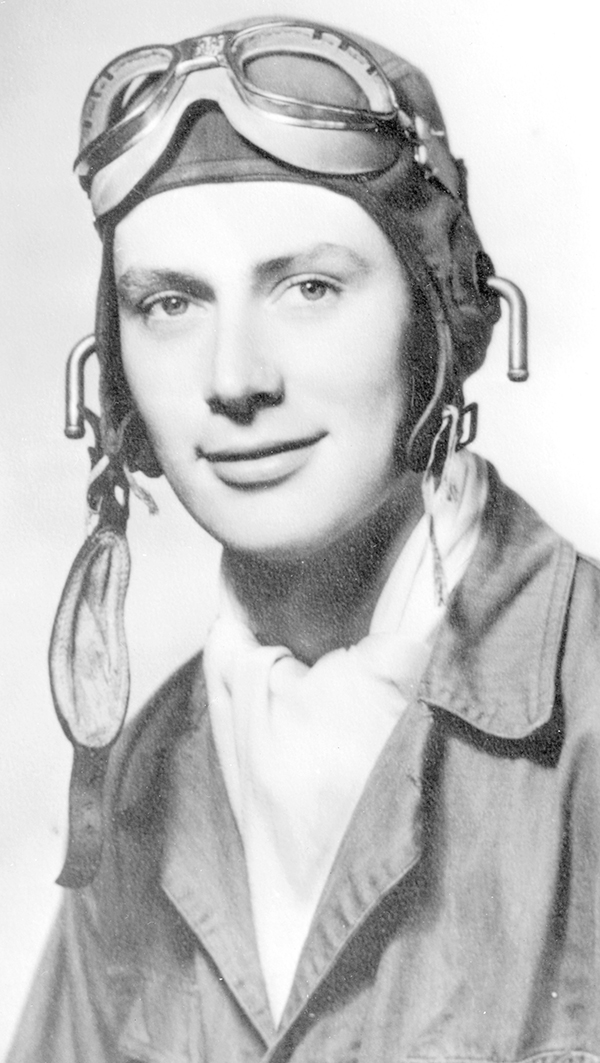
George Laur served in the Army Air Corps during WW2.
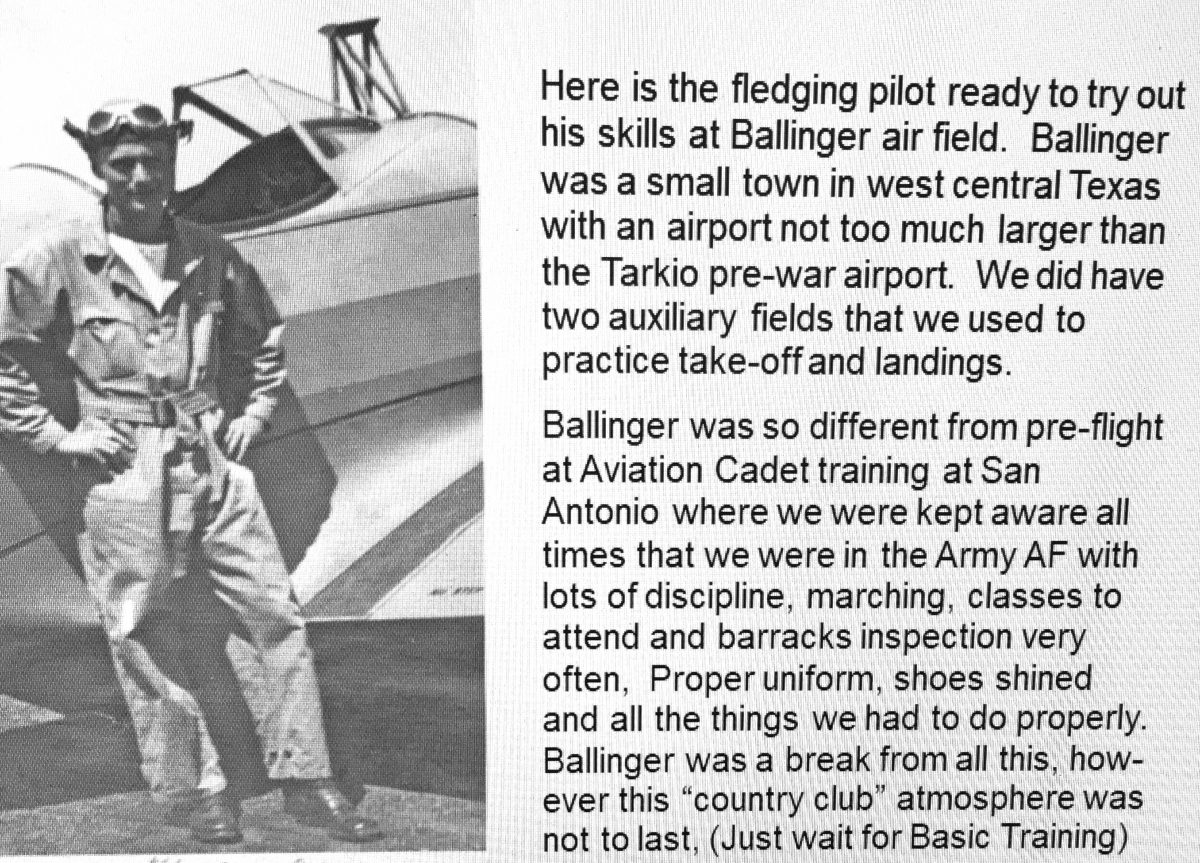
Here is the fledgling pilot ready to try out his skills at Ballinger air field. Ballinger was a small town in west central Texas with an airport not too much larger than the Tarkio pre-war airport. We did have two auxiliary fields that we used to practice take-off and landings. Ballinger was so different from pre-flight at Aviation Cadet training at San Antonio where we were kept aware all times that we were in the Army AF with lots of discipline, marching, classes to attend and barracks inspection very often. Proper uniform, shoes shined and all the things we had to do properly. Ballinger was a break from all this, however this “country club” atmosphere was not to last. (Just wait for Basic Training.)
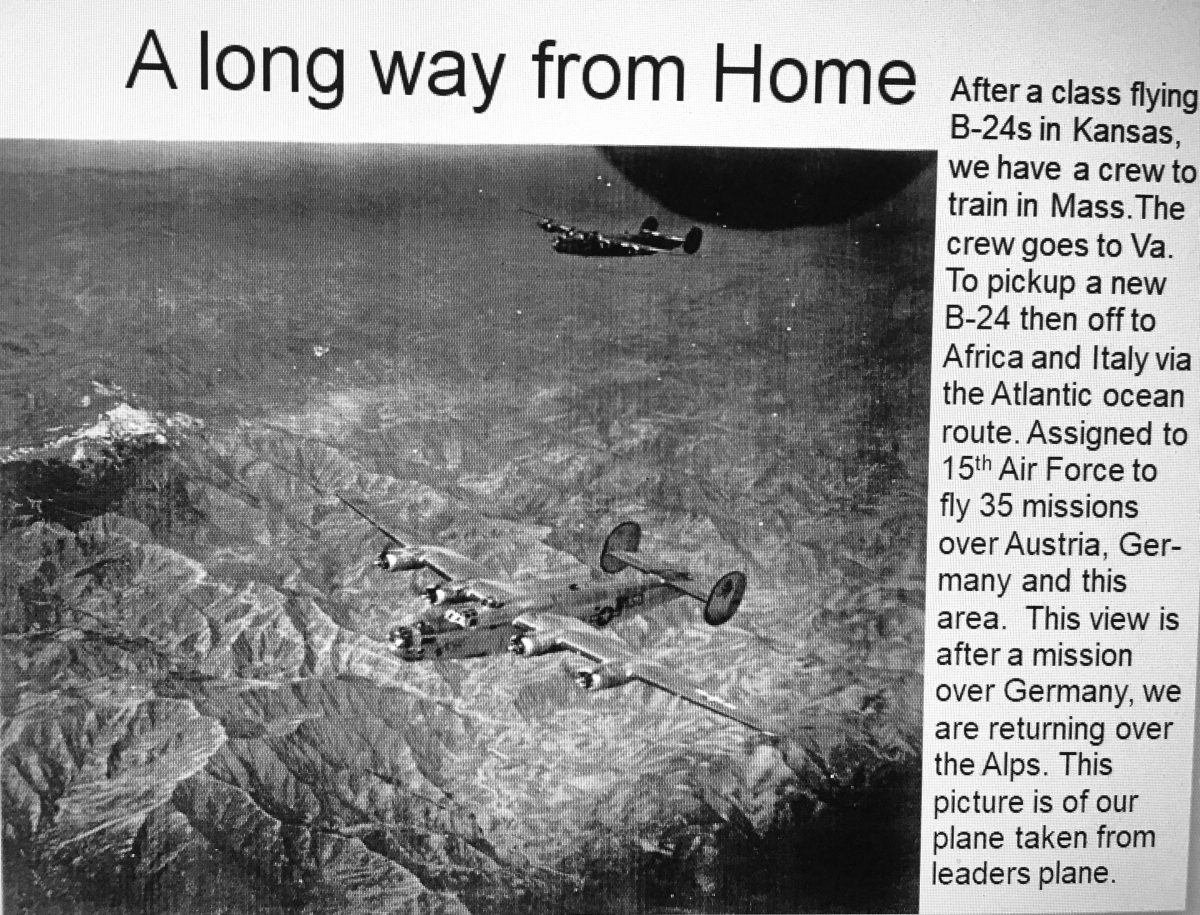
A long way from home: After a class flying B-24s in Kansas, we have a crew to train in Mass. The crew goes to Va. to pickup a new B-24 then off to Africa and Italy via the Atlantic Ocean route. Assigned to 15th Air Force to fly 35 missions over Austria, Germany and this area. This view is after a mission over Germany, we are returning over the Alps. This picture is of our plane taken from leader’s plane.
By Beverly Clinkingbeard
Atchison County and the United States of America met George Clark Laur September 20, 1921, the newborn son of Tom and Catherine Clark Laur. While they must have known their bundle of joy was quite special, they probably did not realize the many world, technical and societal changes their son would see and experience.
George was two years old when the family moved to the farm home west of Westboro, built in 1904 by his grandparents, George and Flora Laur. It’s where George still lives. As a lad, he attended Morning Sun country school (the building still stands on the corner of R Avenue and 120th Street) and in 1939, George was a graduate of Westboro High School. Following high school, he attended Tarkio College and enrolled in the Civilian Pilot Training (CPT) course. Meanwhile, Peterson Field (Tarkio) was being developed as one of a series of air strips across the country to serve the new interest in airplanes, civilian and military. As well, the news from Europe was ominous. Hitler’s Germany walked across Europe conquering one country after another while England endured nightly bombings by the Luftwaffe.
George went “active” in the Army Air Corps in 1942. (In 1947, the Air Corps name was changed to the U.S. Air Force.) His first stop was Jefferson Barracks, St. Louis, with the next stop being Eu Claire, Wisconsin. There he received basic evaluation, training, inoculations, and warm clothing issue. Wisconsin was very cold, but they were soon on their way, by a very slow train, to San Antonio, Texas. They arrived in their winter woolies to hot temps and were soon peeling off their coats. Here, as in future moves, there were classes and evaluation. Next was Plainview, Texas, where he flew a PT17. A few weeks later he was in San Angelo, Texas, flying a basic trainer. On arriving in Lubbock, Texas, George and another mate exited the train and they were called out to take charge of the cadets because of previous training and personal potential. This meant extra duty, even to the business of rousing 300-400 guys for reveille. (He remembers it as, “What a headache!”) At Lubbock, the cadets graduated to twin engine air craft. They were called “bamboo bombers” as they were constructed of plywood and fabric, and on one occasion an engine quit and George and the instructor had to utilize their parachute. Since they were in the middle of “nowhere,” they caught a ride with a family driving a Model A Ford to Plainview and the base sent a vehicle for them. Meanwhile, George was granted a pilot’s license and graduated to the Army Air Corps, and somewhere in that timeline, George had the mumps. It kept him from moving on with the group he had started with and was reassigned to a new group. Now that he was a pilot, he was issued the new style bomber jacket.
He was granted a furlough and on return to Texas sent to Liberal, Kansas, where he made “quite a leap” from flying bamboo bombers to B-24s. He was also introduced to his new crew and together they began their next phase of training. They would train as a team and would stay together from there on. There were two pilots, a navigator, bombardier and six enlisted men. Training became more intense and accelerated as the Army was desperate for air power. Their next stop was to Connecticut and they practiced flying over congested areas, mountains and ocean. They were granted another leave and afterwards went to Washington, D.C., where they picked up a brand new B-24. From there to Massachusetts, Newfoundland, and at the Azore Islands, they waited for good weather to fly across to Africa and finally, their destination, southern Italy. The enemy still held northern Italy.
Their accommodations were “rustic” as described by George, “We made a ‘stove’ out of a five gallon pail with a burner in the bottom of a gallon fruit can, made holes in the can to let in air and used copper tube to bring in fuel oil (had to add some 100 octane – it worked) and a stove pipe. We found plywood for a door and framed the tent with wood.”
They supported ground troops and bombed fuel and ammunition depots, railroads, roads, and military installations, always with the aim of disrupting enemy supply lines.
“Were you shot at?”
The response was an emphatic, “Always! The sky below would be dark with smoke from anti-aircraft fire.”
George described their duty with a paragraph, “If you could see the crew close-up you would see a tired bunch of guys. This would be late afternoon, we had been up since the call for briefing at about 3:00 a.m., briefing on target, route, and possible problems, take-off formation to target and return and landing. The landing another experience with lots of traffic, prop wash.” George also received word that he had graduated from Tarkio College. So much for pomp and circumstance! There was a war to win.
One high point was a period of rest and relaxation on the Isle of Capri. Before being routed out of southern Italy, the enemy had used the holiday spot as their place of rest. The hotel, though not the luxurious spot it once was, still had a restaurant with waiters, white tablecloths and ironed napkins. George said, “It was quite a change from the mess hall at Cherignola Air Base.”
Meanwhile, the crew had flown over Austria, Yugoslavia, Czecholavakia, the Alps and Germany. In 1945, the crew had completed 35 missions that lasted eight to 10 hours each mission. It was time for rotation. From Naples, Italy, George boarded a cruise liner that was retrofitted for troops – three bunks stacked atop one another. They sailed two days in the Mediterranean Sea and five days later into Boston Harbor. George chuckled, “There was a large group of women meet the ship and the men all ran to the dockside to see the greeters. The ship listed and we were ordered back to our places.” While George was sailing home, his co-pilot left a few days later and caught a flight with another crew. He arrived stateside at about the same time.
George was granted leave and casually mentioned, “That’s when Mary Jane (Hoshor, a 1942 Westboro High School graduate) and I decided to get married.”
He was reassigned to the Long Beach, California, area and Mary Jane went along. They stayed with an aunt while George was debriefed and had reorientation classes. The war had wound down in Europe, and once Japan surrendered, George’s job was over. He and Mary Jane turned toward home.
George returned to farming west of Westboro and is also known for Morning Sun Seed. He and Mary Jane had four children, Barbara, Linda, George, Jr., and David. A daughter remembered they always took a summer trip and visited the aunts in Long Beach. She described their trips as, “The station wagon was full and we had a good time, but I do recall once when we turned into our driveway, my dad did kiss the ground in gratitude.” After all, there is no place like home.
“George, did you ever return to Italy and the other countries to visit where you had been?” With a negative nod, he said, “No, I didn’t. I guess life here was busy and somehow it never happened.”
After Mary Jane’s death, George banged around his big house for seven years before marrying Patty (Gutsch) Broermann. They enjoyed many years together before she passed away.
George’s life has been marked with an interest in the community, being a good farmer and being a good neighbor. He has served and supported many boards and committees. In return, he humbly suggested the community has been good to his family.
Thank you for being one among us, George, and thank you for your service. You made a difference, and though it is a few days early, we wish you on your 100th year milestone, a big HAPPY BIRTHDAY!!
’Til next time . . .


