


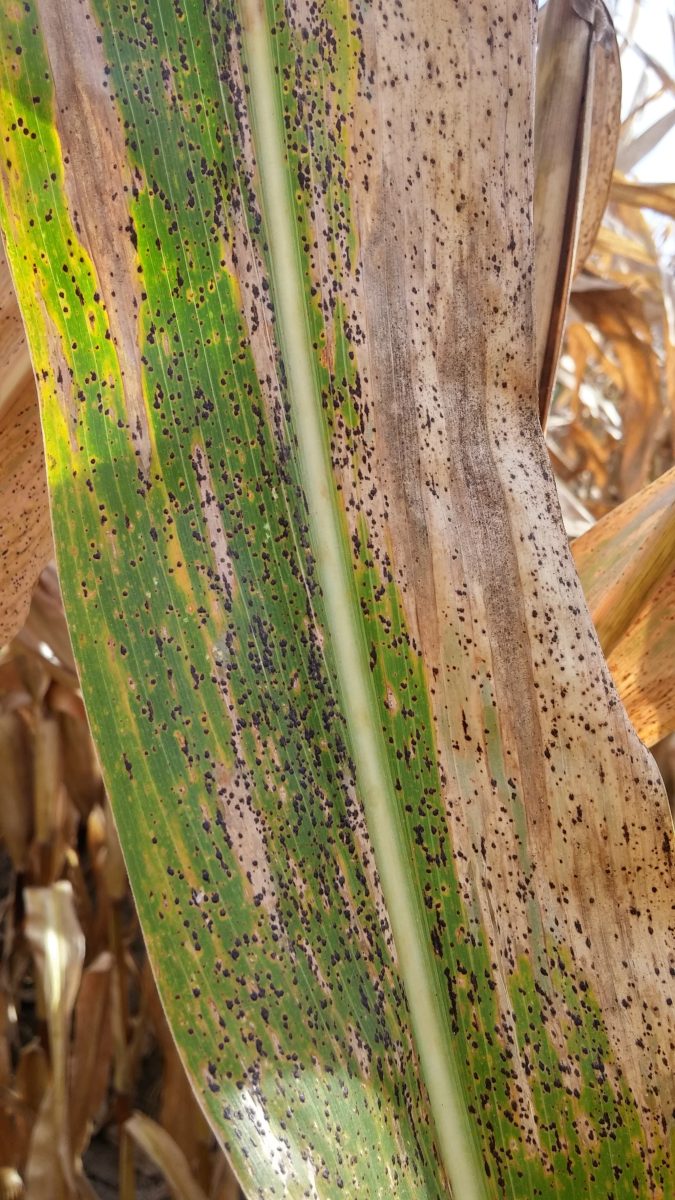
Stroma of tar spot covering a leaf with both green tissue and brown senescing tissue. Multiple diseases can occur with tar spot. These black raised dots are the stroma of the tar spot pathogen, which overwinters on residues at the soil surface. (Photo by K. Wise)
Tar spot has not been found in northwest Missouri, but has been found in a few counties along the Mississippi River in northeast Missouri. To accurately detect this disease, it should be submitted to the MU Diagnostic Laboratory to be confirmed as other diseases can be misdiagnosed for this disease.
Several reports and individuals have thought they have found tar spot, but found out it was other look-alikes. Insect frass has been misidentified as tar spot. Also, southern rust can look like tar spot as rust can turn dark later in season. Tar spot is hard to rake off the leaf surface with your fingernail. “We continue to look and scout for this disease and will report when and if we find this disease locally,” said Wayne Flanary, Field Specialist in Agronomy.
Tar spot is caused by a fungus that attacks corn which is from Central America. The symptoms are small, raised black spots that can occur on both the top and bottom of the corn leaf. The disease is found in Indiana, Illinois and Michigan.
Tar spot is typically found during milk to late grain development. Most of what we know is from its study in Mexico and Central America.
If you are suspicious of disease that is tar spot, contact your local extension office so they can follow-up. Another option is to send a sample to the crop diagnostic laboratory at University of Missouri. Either way, the actual disease needs to be confirmed.
For more information, contact Wayne Flanary, Field Specialist in Agronomy, University of Missouri Extension at 816-279-1691 or cell phone 913-220-3670.


