


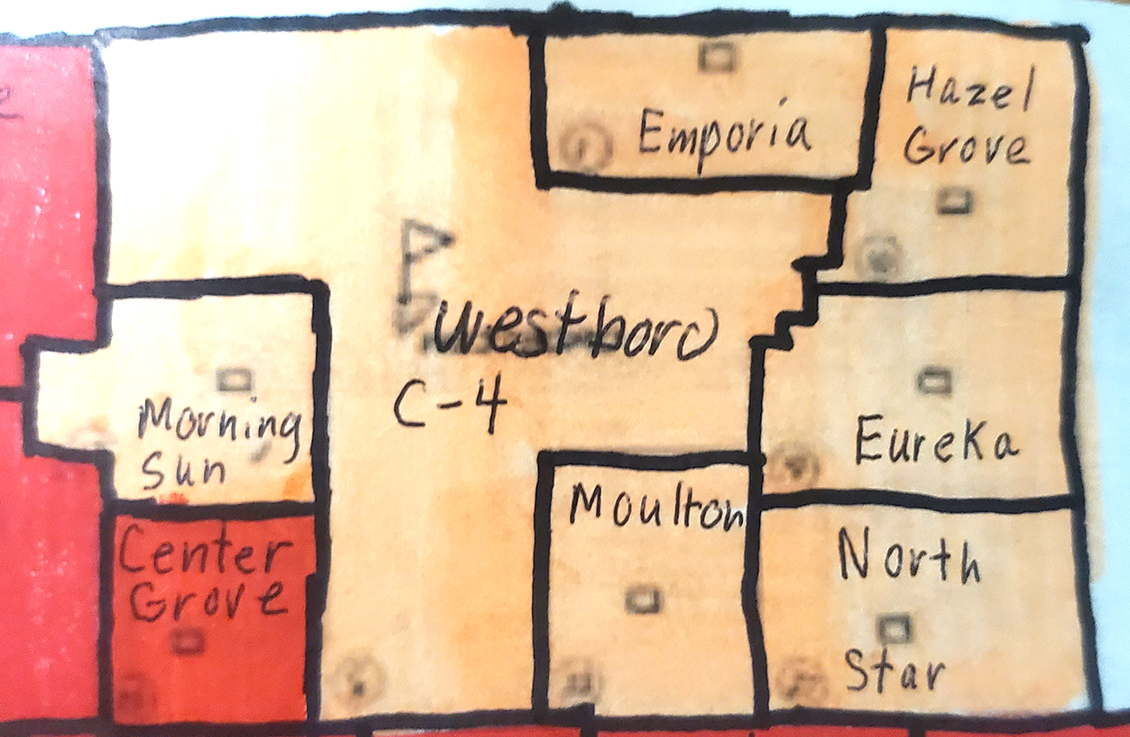
Boundaries of the Westboro R-IV School District.
By Matthew Barnes
We left off the last edition of “School days gone by” (published January 19, 2023) with the opening of the Westboro School gym. At the same time another major change was in the works in the school district.
In 1951 the reorganization movement came to Atchison County. The proposed Westboro R-IV district was to include Westboro C-4, Hazel Grove, Emporia, Eureka, North Star, Moulton, and Morning Sun. George Laur, who served on the school board shortly after the reorganization, stated the reorganization proposal was heavily favored in the community. Morning Sun had two pupils that year, Emporia had been tuitioning students to Westboro since 1947, and Moulton had begun to tuition kids to Westboro in 1950. Lower taxes and free high school tuition were also major incentives. Transportation was a factor. George Laur stated that when he was in school in the Morning Sun district, he had to walk a mile to the corner to get on the Westboro bus to go to town to high school, and occasionally had to walk all the way into town.
In August of 1951, reorganization passed overwhelmingly with 247 voting for and 128 voting against. Following reorganization, the district purchased mud busses also referred to as “chicken coops” to transport all the children within the new district to the central school. These mud busses were able to navigate the muddy dirt roads effectively and rarely got stuck. Morning Sun and Hazel Grove were closed, but North Star and Eureka continued to operate until 1954.
The Westboro district was by far the smallest of the five proposed reorganized districts geographically and demographically. A large part of that was due to the exclusion of the rural districts to the west. For reasons unknown, Yale and South Dale were included in the proposed Tarkio R-I district despite being closer to Westboro. It appears as though there were petitions within those districts to join both Tarkio and Westboro. Why Tarkio was favored over Westboro is unknown. George Laur stated, “It was a big mistake to not include the rural schools to the west.” Apparently, those opinions were shared as Westboro unsuccessfully attempted to annex South Dale and Yale in 1953.
Basil Frazier, the superintendent at Grant City, took the helm of the district in 1952. The reorganization allowed Westboro to make a number of facility improvements. All windows were repaired or replaced in 1953, and a steel quonset hut was constructed for maintenance and storage. In 1954, the plan to renovate the old gym into a cafeteria and kitchen was finally completed. Around that time the need for improved Vo-Ag spaces was realized. At that time Westboro R-IV had not disposed of all of the old country schools. It was decided to move the old Chicken Bristle school into Westboro to be converted into a Vo-Ag shop. Chicken Bristle was chosen as it was the largest and in the best shape of the closed schools. With the help of shop students, the Chicken Bristle school was moved in 1954. The building was cut in half and moved into Westboro, where it was rejoined atop a high cinder block basement. Later, music class was also held in the building.
Rumors of the Westboro School closing began in 1965. The district received a citation from the state for not offering two state-mandated classes. While the issues were corrected immediately and the district retained accreditation, several students chose to attend Tarkio High School. To make matters worse, longtime superintendent Basil Frazier resigned to take the principal job at Kiron, Iowa. Harold Smith who previously had served as high school principal at Nodaway-Holt, took the helm at Westboro. The accreditation issues were corrected and the district continued to offer high-quality education. However, it did come at a cost. Westboro had to pull money out of its reserves to operate during the 1966-67 school year.
In 1967, Harold Smith was hired as superintendent of North Harrison R-III in Eagleville Missouri. The Westboro school board tried in earnest to hire a new superintendent. Advertising all over the region, and reaching out to 25 known qualified individuals only yielded one applicant, a 66-year-old retired administrator. As the school year came to a close with no superintendent, many staff members opted to seek employment elsewhere.
To make matters worse, the high school enrollment had fallen from 67 students in 1965 to 47 in 1967, or a 35% decrease. With things looking dire, the school board made the hard decision to close the high school and tuition out students in grades 9-12 to surrounding schools, primarily Tarkio. School board vice-president George Laur said one condition the Westboro board insisted on was establishing a girls’ basketball program at Tarkio. Tarkio had not fielded a girls’ basketball team prior to that time. The 1968 Tarkio Indian girls’ basketball team made up mostly by former Wildcats went on to have an undefeated season.
The transition to Tarkio was tough for many students. While Tarkio students and staff were welcoming, adjusting from a class of 10 to more than 70 proved to be challenging. Nancy Barrett, who started her junior year at Tarkio, said, “While the environment at Tarkio was completely different from Westboro, I received just as good of an education there and had access to a wider variety of classes.”
Principal Gary Rowland assumed the duties of the superintendent, along with his principal and teaching duties. According to Rita Comstock, many of the high school teachers were still on contract for the 1967-68 school year, so the junior high was retained. Seventh and eighth graders had access to home ec, advanced science, and shop classes. Then school board vice president George Laur recalled, “Our junior high students received the best education in all of northwest Missouri after the high school closed.” However, he stated that it was not affordable to offer those classes to seventh and eighth graders long-term. “We would have had to cut the extra classes, or go into debt,” Laur stated. Wanting to offer their students the best education possible, while remaining financially solvable, the school board decided to send junior high students to Tarkio in the fall of 1968. At that time fourth grade teacher Elmo Mitchell assumed the job of superintendent/ principal.
A tax increase of 25 cents was approved in 1968, allowing Westboro R-IV to rebuild its financial position, contributing to its reserves, while offering a high quality of education for grades kindergarten through sixth. The district consistently performed in the top tier of Missouri elementary schools, oftentimes outperforming larger surrounding districts, all the while spending less than the state average per pupil.
Many former students remember the home-cooked meals offered at Westboro elementary. Many times cooks would start meals at home and bring them to school the next day. Elephant ears, Navajo tacos, grasshopper pie, and chili were some favorites. Some cooks over the years were Norma Mather, Carla Irvin, Joyce Martin, Kris Jones, Reeve Beckman, Merlin Madron, Anna Bell Johnson, Twyilla Gibbons, and Diane Hall.
The community group which helped can food for the school had long since disbanded. However, parents, grandparents, and the community still donated food and desserts to the school.
Former staff members at Westboro R-IV all noted the immense community support. Former principal Jane Walter said, “The Westboro community was always very supportive of our school. The PTO was very involved and always willing to help with whatever we needed.” The support for the school was again reaffirmed when a slight increase in the tax levy was approved in the mid 1980s. Westboro was again facing difficult financial conditions. In order to save money classes were consolidated to two grades per room in 1984. Classes were consolidated to the second floor that year, and the third floor was blocked off in order to save money on heating. A new roof was also put on the school at that time.
Another fond memory of former students was the industrial turn-of-the-century playground equipment. Placed sometime between 1917 and 1925, the Westboro playground would be considered a danger today. It featured the “Tangler” which consisted of a tall post with a bearing on top which had multiple chains with handles on the end. kids would begin to run in a circle holding onto the chains and once they had enough momentum, would leap off the ground and swing around and around. Another popular piece of equipment on the playground was the ocean wave which would swing from side to side while spinning like a merry-go-round.
A traditional merry-go-round was also installed in the 1950s by John Walkinshaw. John’s wife, Anna Walkinshaw, taught first grade at Westboro for many years. Prior to teaching at Westboro she taught first at Emporia, then for over 20 years at Chicken Bristle. Many former students expressed their fondness for Mrs. Walkinshaw, all noting her kind nature and love for pink. Every year on the last day of school her first graders would go out to her farm for a picnic. The garden pond with goldfish and her cookies were always a hit!
Jane Walter came to Westboro in the fall of 1978. A recent graduate of Northwest Missouri State University, she started her teaching career teaching third grade. The next year she transitioned to kindergarten teacher and librarian. Following Elmo Mitchell’s retirement in 1987 after 18 years as the district’s superintendent and principal, the school board elected to promote from within, and to Ms. Walter’s surprise, they offered her the position.
In the early 1990s, the school was faced with a series of challenges from the state: The Missouri School Improvement Program (MSIP) went into effect, which imposed new requirements for schools. Westboro received six citations under the new requirement which included: the lack of licensed music and art teachers, and that the principal serves as principal for at least two hours of the school day. To address these issues, beloved music teacher Mary Alice Staples was let go, a stipend was paid to the Tarkio art teacher to provide a curriculum for Westboro students, and the part-time janitor, who had a teaching license, relieved Ms. Walters of some of her teaching duties so she could dedicate two hours of the school day to her administrative duties.
Westboro received its AA accreditation at the end of the 1993-1994 school year. However, Missouri law allowed students to tuition out of unaccredited districts at said district’s expenses if the school went two years without meeting accreditation standards. A handful of Westboro students chose to go to Tarkio in the fall of 1994, further hurting Westboro. That’s not to say students weren’t receiving a quality education as Westboro Elementary continued to boast high test scores.
Further crippling Westboro’s financial situation was the extremely high cost Tarkio charged Westboro to send their high school students to Tarkio.
In 1993, Westboro paid Tarkio $170,000, or 46% of the district’s budget for Westboro students to attend Tarkio High school. In the early 1990s the Westboro board considered sending all their high school students to South Page High School in College Springs. The tuition was significantly less than Tarkio’s, but the board decided the sudden transition for high school students would make the plan unwise.
Not long after the accreditation issues at Westboro had been resolved, Ms. Walter received a phone call from the elementary school principal at Jefferson C-123 at Conception Junction. She informed her that she was retiring and strongly urged Walter to apply. Initially, Ms. Walter turned down the offer because there was still much to do at Westboro and she loved the tight-knit community, however, she eventually agreed to an interview. The Jefferson school board offered her the job, and after much contemplation she accepted. “I hated to leave because of how much I loved being at Westboro, Walter said. “But it was a chance to move close to my dad,” Walter said. “I enjoyed my time at Westboro R-IV and still cherish those memories.”
Rhoda Sorenson succeeded Ms. Walter in the fall of 1994. The district elected to contract Tarkio Superintendent Robert Bruner to handle the district’s finances. Mrs. Sorenson had previously taught kindergarten at North Nodaway and had recently received her license in administration. “I wanted to take a step into administration to see if I would like it,” Sorenson said. “Westboro offered me the opportunity to be a principal while continuing to teach kindergarten. Westboro’s future was uncertain at that time, and I thought if I didn’t enjoy being a principal I could transition back to teaching full-time.”
Due to the multiple financial issues and depleted reserves, Westboro was expected to have a budget deficit of $23,000 in the 1995-1996 school year.
A tax levy increase was placed on the ballot for the April 4th election to address these issues. The levy would have increased the tax rate from $4.45 to $4.50. The need for a levy had been recognized for a number of years, but the board was reluctant to place it on the ballot until it regained accreditation. School board member Carol Kirkpatrick stated, “We were still offering a good education at Westboro, but we just ran out of money.”
The tax levy increase failed, and at the April 10 meeting the school board voted to close. Residents unanimously chose to join Tarkio R-I, and on June 30, 1995, the Westboro R-IV School District ceased to exist. Westboro’s closure resulted in a much lower tax rate for district patrons and allowed Tarkio to retain two sections per grade. Teaching positions were offered to Westboro teachers at Tarkio but most elected to retire. Rhoda Sorenson accepted the Elementary principal job at Tarkio, and stated, “Westboro’s closing signified a changing of times and while Westboro’s closing was sad, students went on to receive a good education at Tarkio.”
Members of the final school board were Ed Nims, Carol Kirkpatrick, Blake Hurst, Francis Stockstill, Julie Umbarger, and Wendell Johnson. The final enrollment at Westboro Elementary was 55 students in grades Kindergarten through sixth. Tarkio teachers and staff took assets of value to Tarkio so they could continue to be used by students. The building and remaining assets were sold to the city. The school was demolished in 2017 after years of deterioration, and a park shelter and a monument to the school were placed on the site.
While it is sad that the Westboro School is gone, the memories made there will last forever. Its legacy lives on in the excellent education Westboro kids now receive at Tarkio R-I, and if you attend any sporting event, you will see that Westboro kids are once again wearing Black and Orange, not as Wildcats but as East Atchison Wolves.


