


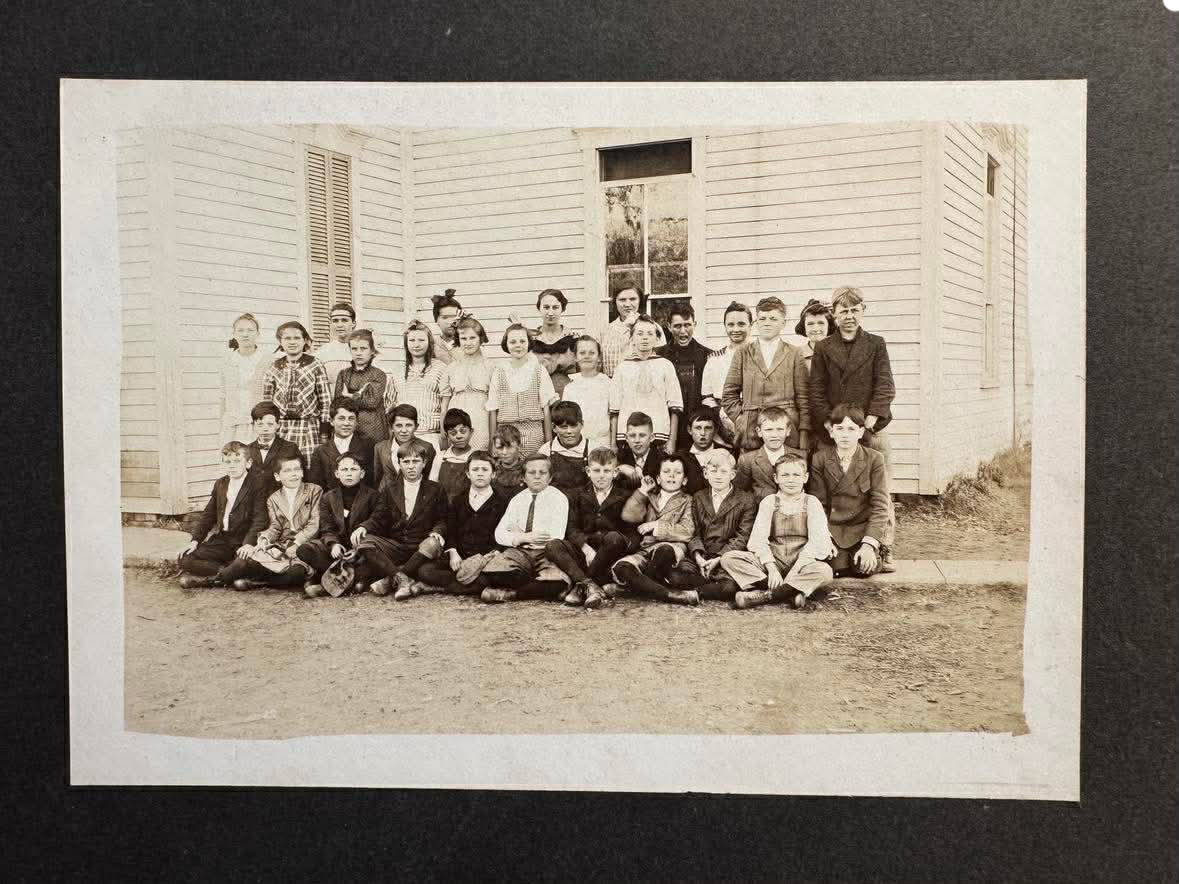
Mary Dunham (at the time, Mary Beckman) is the teacher in this photo of the 1915-16 middle school class.
The remembrances of Mary Dunham
By Beverly Clinkingbeard
In 1981, Betsy Chapin was teaching the fifth and sixth graders at Westboro Elementary School in Westboro, Missouri. The pupils were given the assignment of asking a senior citizen, their grandparents or a friend, to write an essay of what their school days were like. Those who were asked were in school at a time when essay/story writing and penmanship were a part of their curriculum. As a result, their remembrances were well articulated and the handwriting quite legible or type written. In the coming weeks, their experiences will be shared. Thank you, Betsy, and thank you to the contributors, now deceased, for sharing their yesterday experiences.
Mary Dunham
The Dunhams were early day settlers of Westboro, as were the Beckmans. Mary Louise Beckman Dunham is buried in Center Grove Cemetery. The Beckmans were of the German emigrants that settled in Atchison County, west of Westboro. Mary’s father, Henry, had a restaurant and meat market in Westboro. She graduated from Westboro High School in 1913 and became a teacher at Fairview country school. She attended summer school classes at Northwest Normal School (at what has become Northwest Missouri State University in Maryville, Missouri). She also taught Junior High at Westboro School. She married Glenn Dunham in 1917. Their son, Robert (Dr. Dunham, DVM), cared for area farmers’ livestock. Mary was born in 1897 and died in 1992. She was an active participant in the Westboro community and a member of the Methodist Church. This is her story.
Westboro, MO,
March 18, 1981
Dear Mrs. Chapin and 5th and 6th graders,
Thank you for asking about my childhood and school years. This would be close to 78 years since I was in first grade – so you see that things have changed a lot. And then again, they haven’t changed so much either.
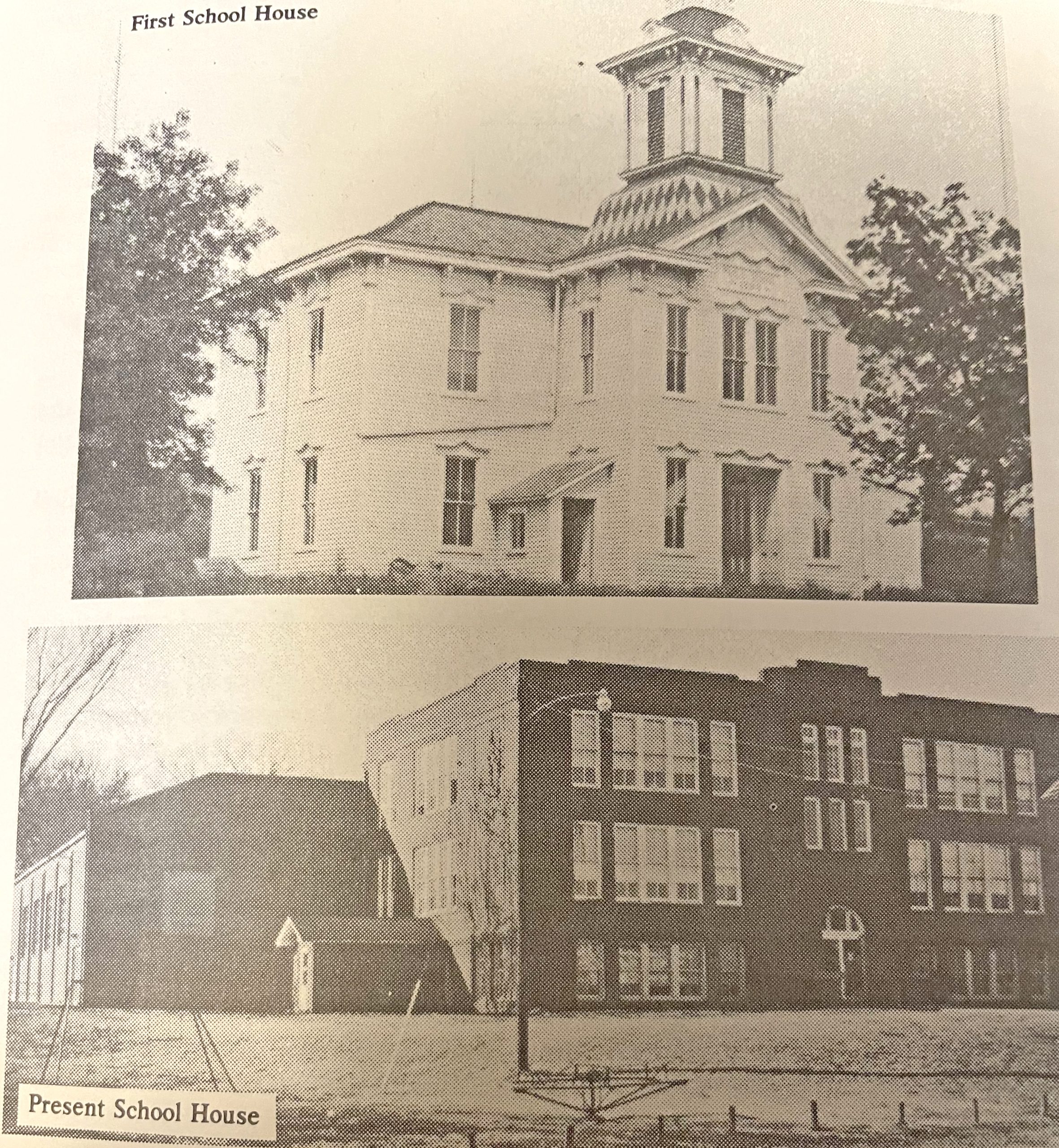
To begin, I always went to town school. The school house was a block south of Mrs. Flack’s house (corner of Main St. & Monroe ) and was a big wooden building, divided into four big rooms: two rooms downstairs for the younger grades – 1, 2 and 3 in one room and 4, 5 and 6 in the other. Upstairs, 7, 8 and 9 were in one room and 10 and 11 were in the other room. There were not 12 grades when I started, but my last year of high school, 12, was added, and was in the building where you are now going to school.
Of course, as was usual at that time, we had no running water, no indoor plumbing, and no electricity. The building was heated by a coal furnace in the basement, with hot air registers in each room.
There were no school busses, since our district wasn’t consolidated, so everyone walked, rode a horse or drove a buggy.
Our school subjects were very much like you have now: spelling, writing, English, geography, history, arithmetic, and reading. Much of our work was oral recitation, because with three grades in a room, correcting papers would be very difficult. Also, paper was expensive, as were pencils. Our writing was in pen and ink, with a pen you dipped in an inkwell at each desk. We had desks that were double – two pupils per desk. Everyone had a slate – a small piece of slate about 10” by 12” with a wood border that was used as you use your chalk board now.
I can’t remember how many were in my class, but after I graduated and went to college, I taught country school north of Rock Port, and had around 30 pupils in eight grades. Mrs. Stites, our County Health nurse, now lives in the remodeled school house where I taught. I also taught in town school, the 4th, 5th and 6th grades, and had 36 pupils.
There were no organized sports except in high school, where we played basketball. I played on the first girls’ team Westboro had. We wore long wool socks, long wool bloomers over our knees, and long sleeved middy blouses, also made of wool. We played in the town hall. Many of the parents and older people of the community were opposed to the idea of girls running around in such skimpy clothing. I wonder what they’d think of the girl’s uniforms now?
We all had to dress warmly, because of the long walk to school. The rooms, even with a furnace in the basement, were very cold. Slacks were never worn, and the material was wool in the winter and cotton in the summer. Our dresses were always well below the knee, about mid-calf.
There were no hot lunches; so we who lived close enough went home for lunch. Those from farther away carried a lunch pail – usually a tin pail that syrup came in from the general store.
Our homes were very much alike. No plumbing, no water, no electricity and no telephones. The water was carried by hand from the well, close to the kitchen door. A few lucky people had a small pump in the kitchen, called a pitcher pump. Of course, all the water had to be heated on the kitchen stove. Everyone, after school, had to fill the wood box for the next day, carry in water, and clean the lamp chimneys. The kitchen was the center of the house because it was always warm, due to the big black range. All of our cooking, canning and ironing was done there. Our irons were heated on the range. Our meat was salted and smoked in our own smoke houses.
My father had a meat market and restaurant on the south side of Main Street, just west of the new fire station. (The fire station Mrs. Dunham refers to is not the most recent fire station built, but the metal building west and across the street from Nutrien Ag Solutions, on the corner of Adams and Main St.) To keep his meat cool in the summer, he had a big walk-in cooler that had to be iced every other day. To supply the ice, he had an ice house behind his meat market. In the fall, ponds were built by damming the Middle Tarkio (Creek), flooding them, and letting them freeze. When the ice was about 12” to 14” thick, the ice crews would start marking the ice into blocks about 2’ wide and 4’ long. Then men with ice saws would saw the ice into blocks and it would be pulled up into wagons or sleds, and hauled to the ice house. There it would be packed into layers and covered all over with sawdust for insulation. This was a very cold job, because it had to be done in the worst of weather.
After the ice was cut, the ponds were allowed to refreeze, and everyone went skating. A large bonfire was built on the edge, and young and old were out on the ice.
We very seldom went out of town, because the two general stores carried not only groceries, but dresses, shoes, hats, yard goods and thread, bedding and furniture. Laura Johnson’s (a local resident, community leader as well as teacher at Westboro High School) father (Oscar Uttvits) ran a hardware store that sold everything from nails and bolts, to kitchen ranges and farm implements. He even re-soled shoes. On the few times we did go out of town, we got on the train in the morning, went to Tarkio, and came back in the afternoon on the return trip of the same train. If you went further, to St. Joseph, you stayed overnight, and returned the next day. Any destination not along the railroad was by horse and buggy, or horseback. A trip to Rock Port to pay taxes was a very long day’s trip – leave before dawn and back after dark. There were no cars when I was small.
Although our life sounds like it was very grim, we really had a very good time. We always had lots to do. Every girl was expected to pitch in to help Mom clean the house, and every boy was expected to help Dad with his work outside.
There were always lots of kids to play with after our chores were done. We played hide and seek, ball, skating and coasting in the winter, popped corn, read stories, and went to church and school programs. Each town had a very large Fourth of July celebration, and we had lots of homemade ice cream made with ice from the ice house, lemonade and cake.
I hope you’ve found these recollections of mine interesting. It has been fun for me.
Sincerely,
Mary Dunham


