


Nancy Greeley who is our Northwest Missouri representative at DESE.
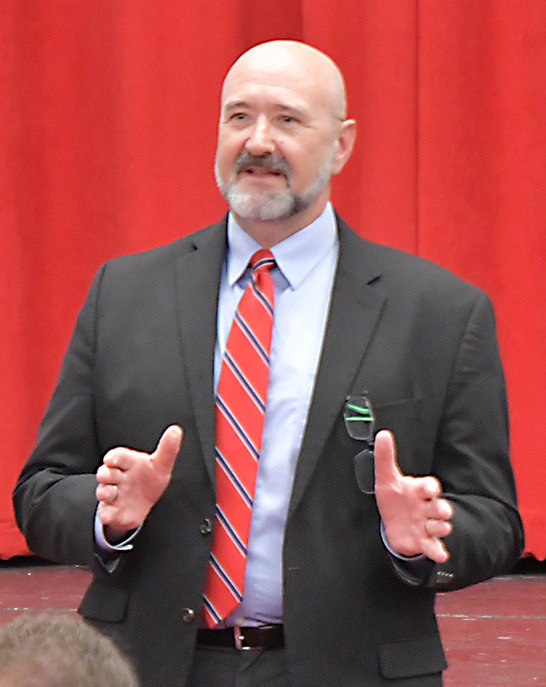
Duane Martin of EdCounsel shared data from the National Rural Education Association.

John Rhinehart talked about school funding formulas and school finance.
Educators, administrators and community members from Atchison County recently gathered in Tarkio for a Missouri Public School Funding Forum focused on the growing financial challenges facing rural school districts. Duane Martin presented some facts on the state of rural education. Nancy Greeley, who is our Northwest Missouri representative at DESE also gave a presentation and John Rhinehart talked about school funding formulas and examined how Missouri funds public education.
A PowerPoint presentation titled “Missouri’s Desertion of Its Rural Schools” was delivered by Duane Martin of EdCounsel using data from the National Rural Education Association. Martin’s analysis sought to answer three central questions: How Missouri compares to other states in educational funding? Whether the state is underfunding rural schools? and What steps could be taken to move Missouri’s rural education system forward?
How Missouri Compares Nationally
Missouri is overwhelmingly rural in terms of public education. Approximately 75 percent of the state’s schools are classified as rural, serving around 200,000 students from pre-kindergarten through high school. Despite this, Missouri’s rural schools consistently produce strong results. Graduation rates are among the highest in the nation and overall student outcomes place Missouri’s rural districts in the top 25 percent nationally.
However, these successes occur in spite of funding realities. State funding for rural schools in Missouri ranks among the worst in the country and Missouri’s education policy is ranked second-worst nationally. The state also ranks seventh for overall concern regarding the future of rural schools, highlighting a widening gap between school performance and policy support.
Is Missouri Deserting Its Rural Schools?
Martin argued that Missouri has effectively abandoned its rural districts through legislative underfunding and shifting financial responsibility away from the state and onto local taxpayers. While Missouri’s constitution calls for approximately 25 percent of state revenue to support public schools, that benchmark has not been met.
Since 2016, the local share of education funding has increased by 4.8 percent, while state funding has declined by the same amount. This shift places increased pressure on rural communities with smaller tax bases.
Additionally, concern was raised over the MOScholars program, which provides tuition support for private schools, homeschool families, and similar alternatives. The program will distribute approximately $50 million this year, yet 89 percent of those funds will go to urban and suburban areas. Suburban St. Louis alone accounts for 58.5 percent, while rural taxpayers help fund a program that largely does not benefit their communities. Presenters noted that the same $50 million could provide roughly $57 per student for public schools if allocated differently.
State mandates were also highlighted as a growing burden. Over the past decade, the number of requirements districts must complete annually has increased ten-fold, adding administrative strain without corresponding financial support.
Consequences For Rural Communities
Speakers emphasized that when funding leaves rural schools, the consequences are immediate and tangible. Teacher positions are cut, class sizes increase, services and programs disappear, and in severe cases, schools are forced to close. Because rural schools often serve as the heart of their communities, closures can accelerate population decline and threaten the long-term viability of entire towns.
Rather than expanding school choice, weakened public schools reduce options for families who rely on local districts. Presenters warned that continued funding reductions risk undermining not only education but also rural Missouri’s social and economic stability.
Understanding Missouri’s School Funding System
Additional presentations provided insight into how Missouri funds public education. Nancy Greeley, a Northwest Missouri DESE area representative, reviewed funding data for the 59 school districts in her region. Of these, only 15 are currently funded through the state formula, while 44 remain in “hold harmless” status.
John Rhinehart followed with an overview of Missouri’s school finance structure, explaining the different district funds, revenue sources, and the state funding formula. He also outlined upcoming formula changes and projected budget shortfalls. The State Adequacy Target (SAT), originally set at $7,145, is expected to fall to approximately $6,964 this year and potentially $6,743 next year. Transportation funding, which had been fully funded for three years, is also expected to see an 8 percent reduction.
Looking Ahead
The forum concluded with a call to action for educators and community members to remain informed and engaged. Attendees were encouraged to ask legislators how they voted on education-related issues and to advocate for policies that protect Missouri’s rural public schools.


