


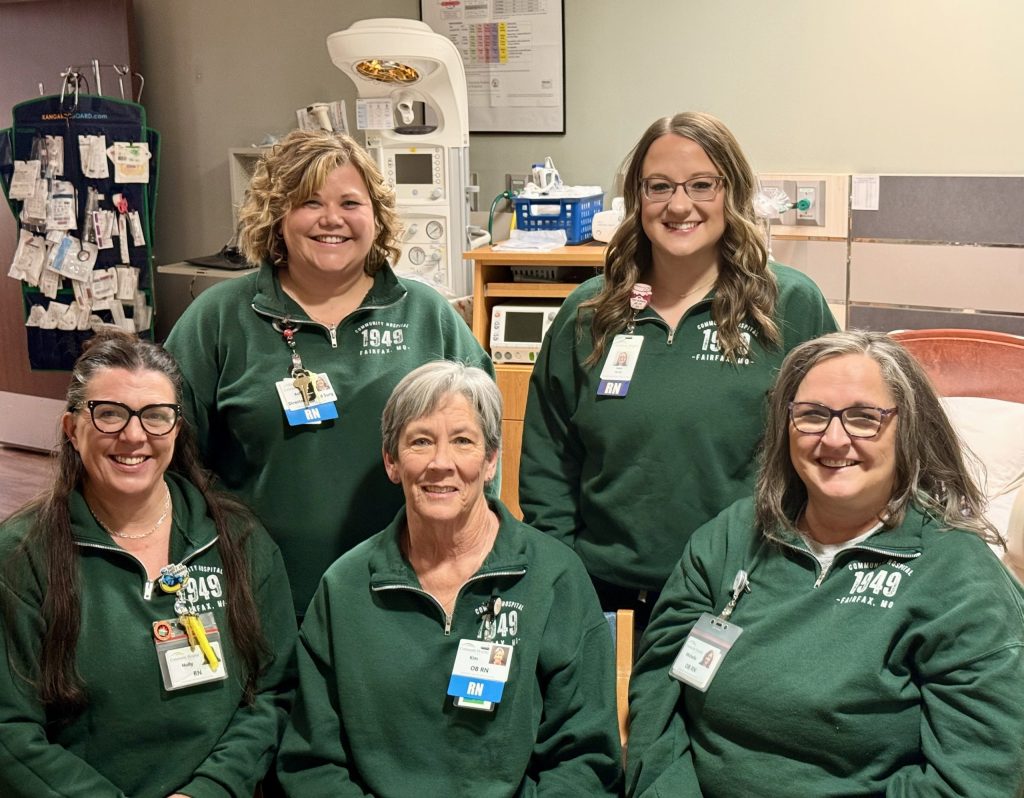
The OB team at Community Hospital-Fairfax includes, from left to right: front row – Holly Gray, R.N., Kim Giles, R.N., and Michelle Bollinger, R.N.; and back row – Ashlee Driskell, R.N., and Kelsi Oberhauser, R.N. (Submitted photo)
Rural hospitals across the country are shuttering obstetrics (OB) and labor and delivery services due to financial constraints, and provider shortages. In Missouri, 42% of counties are classified as OB deserts. Meanwhile, the OB team at Community Hospital-Fairfax (CH-F) is making big strides to raise the bar for rural maternal and neonatal care in our community and across the state.
The OB team at CH-F is a part of the Missouri Perinatal Quality Collaborative (PQC), a statewide program focused on bringing hospitals together to develop evidence-based practices, track results, and continuously improve outcomes for mothers and babies.
“For CH-F, this means we are aligning ourselves with the highest state and national standards for obstetrics and neonatal care. We have been focusing specifically on two initiatives: obstetric hemorrhage, and the maternal-infant dyad affected by substance use disorder. We are using standardized guidelines, education, and data tracking to ensure we are prepared for emergencies and ready to provide compassionate, consistent care to both mothers and babies,” said Ashlee Driskell, Director of Nursing.
CH-F’s work in obstetric hemorrhage has been ongoing since 2023. The OB team implemented use of an obstetrical hemorrhage cart which enables them to measure blood loss in real time to determine if another intervention is needed. One of two interventions, the JADA system, is housed in the cart. JADA utilizes low-level vacuum to induce a contraction and restrict blood flow.
The second area of focus for CH-F is the maternal-infant dyad affected by substance use disorder. This initiative includes more extensive screening and assessment for newborns, a protocol that prioritizes non-pharmacological care, and the implementation of the eat, sleep, and console model of care which prioritizes a newborn’s ability to perform basic functions over medical interventions. This approach often decreases the need for transfer and keeps newborns with their mothers whenever it is safe to do so.
“Our protocol is to prioritize non-pharmacologic care first. That means supporting bonding, decreased stimulation, encouraging skin-to-skin, and creating a calm environment for both mother and baby. This initiative is about treating mom and baby as one unit because what affects one, affects the other. At the end of the day, this initiative is about meeting families where they are, reducing stigma, and providing compassionate, supportive care. These are our people. Our neighbors. Our families. This work is about making sure moms and babies are safe, supported, and cared for close to home,” said Michelle Bollinger, OB nurse.


