


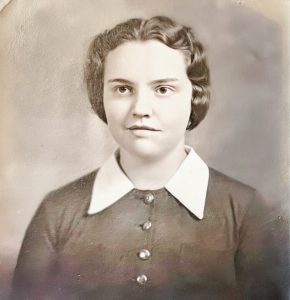
Submitted by Beverly Clinkingbeard
Katherine Rankin Barker was a teacher and contributor to the Betsy Chapin 1981 Remembrance of Childhood School Days articles that ran the past few months in the Atchison County Mail as “Westboro fifth and sixth grade assignment.” She also wrote about her family and the era of The Great Depression. Children today are not subject to the memories of The Great Depression generation because that generation is deceased. Great-grandparents and grandparents recall their parents saying, “Back during the Depression, we . . .” and the deprivations and saving ways were told, some in story fashion and others as a directive, such as, “Don’t throw that out! You may need it tomorrow or the next day!” “Waste not, want not.” The Depression began in 1928 and extended through the “dirty thirties.” It altered our national personality just as WWII did. Katherine Rankin Barker gives us a glimpse of that era with her remembrances of before and during The Great Depression. For instance, unemployment in 1933 was an estimated 24.9%; in 1938 it was 19.%. Roughly one-third (200,000) of all American farmers were facing farm foreclosure in 1933.
As previously written, the 1930s era was a life challenging time for most folks. William McKee Rankin was proprietor of Caine Rankin Lumberyard & Farm Equipment. A national stock market crash, farm foreclosures, banks closing and a combination of factors that had global implications, all took a toll on many businesses and individual households. With 200,000 farm foreclosures and extremely high unemployment rates, people spent for necessities only. This is more of Katherine Rankin Barker’s story that describes the years of The Great Depression and her quest for employment:
“When I was a senior at Tarkio College in 1936, I was very anxious to get a teaching job to pay back some of my college debts and start earning my own keep. I had applied for several jobs in the local area, but this was still Depression times and jobs were very hard to find. I had met Dorothy Smith of Gallatin, Missouri, when I worked in Hollester, Missouri, in 1932-1933. We had kept our friendship with letters. She was teaching at Jameson, Missouri, High School and wrote of a possible vacancy in the high school at Altamont, Missouri. I wrote the superintendent and they were anxious that I apply for the job.
“Meanwhile, since Papa sold lumber and farm equipment, which was horse drawn, we felt the effects of the Depression. Many people owed Papa, so he took some land from one of the ranches as payment, but there was already a mortgage on it. Mom and Uncle Charlie had a farm together and the folks had bought Uncle Charlie out. They had borrowed money from the Prudential Insurance Company and eventually lost the land. They were able to keep our home, but in the late 30’s the lumber yard also was sold because of debts. I’m sure it was a time of great distress for Papa and Mama. It was even hard to pay the milk and grocery bills.
“The drought that hit in 1934-1936 made things even harder for business and the farm. In 1934, the corn was burned up by June. It was a help for May (sister) and I to work at Hollester in 1932-1933, but after that we could not get summer work.
“I did not get a senior ring as we didn’t have the money. Many of us were in the same situation. May quit college and taught school two years before coming back and graduating with me in 1936. Teaching jobs were very difficult to get, so the college gave me some jobs to help with my tuition. Uncle Orval also sent us clothes and helped with some of the money for college. We were never cold and we were never hungry, but we hated to ask Papa even for ten cents to go to the show. They had special nights at the theatre when everyone signed up and would stand outside hoping to win the jackpot. We did a lot of reading from the library. Our friend, Peggy Griffen, still had the swimming pool and we could swim there. They were still wealthy. We would take walks at night, play tennis, play cards – most of our friends were poor, too. We always attended church and group activities at church.
“As mentioned, I had heard there was a possible vacancy at Altamont High School. I had never heard of Altamont and I made inquiry and found I could take a bus to St. Joseph from Tarkio, then go on by bus to Altamont. I wrote to the superintendent and the response was for me to apply for the job. The folks and I scraped up enough money for the trip. I wore my blue and white shoes and a navy-blue dress with jacket and a smart blue hat.
“When I arrived at Altamont, I inquired where the superintendent and school board members lived. Since I had no car, I walked to see each one and some lived far out into the country. It was very dry for April and the men were working out in the fields as it was corn planting time. They were all so friendly and kind. Although my heel had a blister, it was worth it.
“That night, I met with the board at the post office as the postmaster was secretary of the board. They were impressed that I could teach music and they gave me a contract for $80 per month. I had inquired at the restaurant where I might stay for the night and she directed me to the home of Mr. and Mrs. Freeman. I slept in a feather bed and had a breakfast of oatmeal. They were very good people. And, that night it rained a good rain.
“I got back home on my 21st birthday, April 26, 1936. When the folks returned from church, I had my contract out on the table. How thankful we all were.
“As the summer of 1936 came, it was dry and the hottest we had ever seen, and with it came grasshoppers. The over 100 degree heat of the summer of 1936 lasted for days in August. We had to sleep out on the porch at night. The folks sprinkled water on the sheets to cool them down. Because of hard times, our electric refrigerator had failed, and there was no money to get it fixed. Poor Papa would bring a 25 cent chunk of ice home in a gunny sack on his back to put in the ice box. Our furnace also had trouble, so sometimes it smoked. We did not have money to repaper the walls over worn and dirty spots, so we covered them with maps and calendars.
“When I moved to Altamont, I found people were even worse off than at my home. Grasshoppers had even ate the fruit off the trees. Farmers were feeding tree limbs to their cows. There was no crop at all.
“During my years at Altamont High School, I taught English, history, music, speech, sponsored Girls’ Rally, and was also principal one year. I loved my kids, the teachers, and the wonderful support of the community. Coming to Altamont was to shape the rest of my life. It brought happy and sad times, but I know it was part of God’s plan for my life. After I retired, I spent eight years at Shenandoah, Iowa, but I was never happier than at Altamont.”
Katherine Rankin Barker
(Katherine Rankin Barker retired from Altamont High School, but interrupted a few years of teaching to marry a farmer, Lynn Barker, and become a mother to twin daughters and a third child. She also was pianist of the church they attended and taught Sunday School for 50 years.)


