


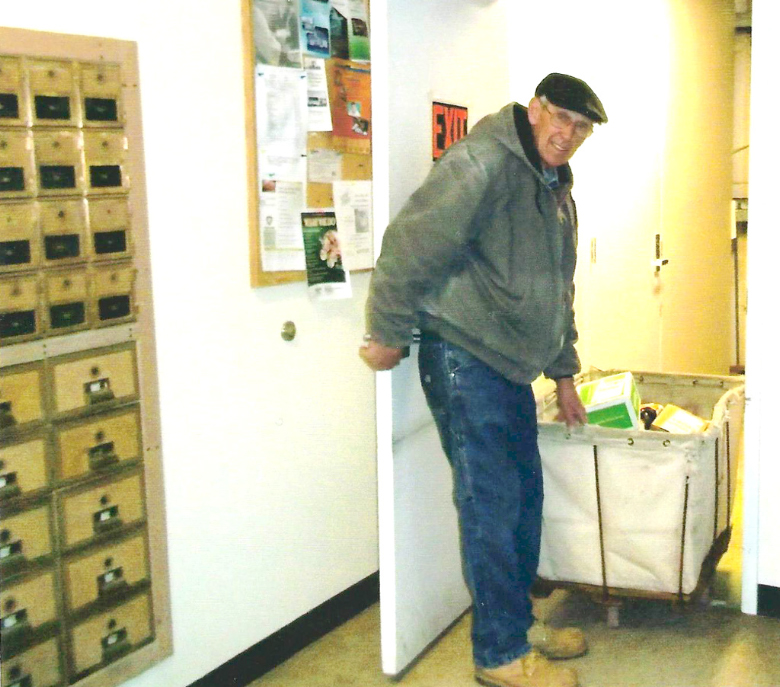
Larry Polsley, prior to retiring, is pictured getting ready to load the mail for delivery.
By Beverly Clinkingbeard
“The mail must go through.”
For thirty-six and a half years, Larry Polsley, rural mail carrier from Blanchard, has adhered to that rule despite rain, snow, sleet and whatever other barriers were placed in his way. He laughs and says he has actually been in government service for forty and a half years when he throws in his time in the U.S. Navy.
Polsley roots are deep in Southwest Iowa/Northwest Missouri. He is the son of Gayland and May [Honan] Polsley, both deceased.
In 1996, Larry submitted an article to a newspaper on the history of the U.S. Mail Rural Free Delivery [RFD] service for their 100th anniversary. The condensed story is as follows:
In 1894, Maxie Jewett of Blanchard read in a farm magazine where Congress had appropriated $5,000 for experimental rural delivery routes. Mr. Jewett urged the Shenandoah postmaster, C.N. Marvin, to apply, and it was around Mr. Jewitt’s kitchen table that the first [RFD] route in southwest Iowa was laid out. It was a service that quickly caught on. Early carriers were allowed to pick up and deliver groceries and supplies to their rural patrons for a small fee, and they were allowed to keep this, for the wages were low. The practice was soon dropped with the establishment of parcel post and better wages. RFD had opponents initially, but it became a popular and vital link between farmers and the outside world, and can also be credited with road improvements in the rural areas.
Being a rural carrier in the early days was not without peril. They endured all kinds of weather and poor road conditions. Most routes averaged 20 miles in length because that was about what a horse could cover in a day, be it by buggy or horseback. Mail carrier, Owen Hixson, astride his horse, set out to complete his mail route. The Tarkio River west of Blanchard was at flood stage. The horse lost its footing and was washed down the river with Hixson on its back. Mr. Hixson managed to reach for a tree limb and was rescued when George Webster, a nearby farmer, heard him yelling. The horse drowned and was found near Tarkio, with the mail pouch still tied to the saddle horn.
Larry can recount adventures also. His route changed many times, yet it has always been out of Blanchard. At the close of his service, the length of his route was as if every day he drove to Omaha and back on gravel roads, with a stop every 3/4 mile. He’s gone through four Chevy Blazers, preferring them because of their narrow body and a place for packages in the rear. His one accident was in a 1977 Ford pick-up, but with his dad and brother’s help, his route was completed. As they drove along the route, he sorted mail, as it was jumbled by the accident. The mail must go through.
Larry has carried mail out of and to Coin, Westboro, College Springs, and Northboro, and his route roughly went as far east as Braddyville and almost as far west as Riverton. Until 911 entered Atchison County, Blanchard mail route served Missouri residents. When driver’s licenses became mandatory, these folks had a Missouri driver’s license with an Iowa address and their identity was often doubted or questioned. One woman, upon hospital admission in Omaha, was told her identification of an Iowa address in Missouri was impossible. “Well, suit yourself,” she replied, “but it’s been that way for us since we moved there in 1940.”
When the Blanchard RFD route first started there were four mail routes. Once vehicles were employed, it dropped to three, then two, and now one. Long term postal carriers of the past were: Arthur Wetmore, David Baggs (a Civil War veteran), Owen Hixson, Guy Baggs, Jim Tinnell (his wife, Reba, carried the mail for him during the war years), Templeton Rice (after WWII he upgraded to a 4-wheel drive Jeep and often had all four wheels chained), Rusty Mullins and Carl Davis.
So now that Larry has retired and doesn’t deliver the mail what is in store for him? He is a historian and has quite a cache of material…in his head and in various hard copies. He also is an accomplished pianist. He says in another year he is relocating. His present home is the former Blanchard Hotel (for a short time it was the home of a popular restaurant). But, whatever he does and wherever he goes we can all wish him the best. Thanks for your service, Larry!


