


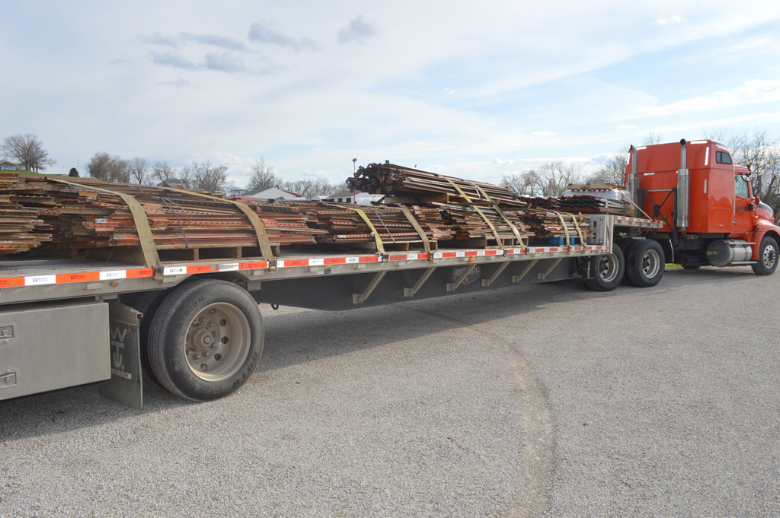
A group of Atchison County farmers gathered together to collect supplies to help farmers and ranchers that were hit by the recent wildfires that spread throughout Kansas, Oklahoma, Texas, and Colorado. Close to $5,000 in monetary donations, as well as over 5,000 posts, 50 rolls of barbed wire, 100 braces, half a dozen hedge posts, a dozen rolls of number 9 wire, and a pallet of mink replacer and horse feed was collected by local farmers and loaded onto trucks in Fairfax, Missouri. The trucks then transported the collection to Ashland, Kansas, where the fires destroyed an area of around 500,000 acres and miles of fencing. Steve Klute, one of the main organizers of the Atchison County relief efforts said, “To get an idea of how big an area that is, Atchison County is about 350,000 acres.” And sadly, Ashland was just one small area dealing with the devastation.
Blake Hurst of Tarkio, Missouri Farm Bureau President, describes the horror and the aftermath:
By Blake Hurst writing for The Federalist
Outpouring Of American Generosity Douses Horrifying Aftermath Of Midwestern Wildfires
After raging wildfires decimated ranches, homes, and businesses, the Midwest is responding en masse with aid. You probably don’t know about it, but you should.
“The flames were forty, fifty feet high, traveling at 80 to 90 miles an hour.” Recent wildfires have seared millions of acres, leaving a swath of total devastation across Kansas, Oklahoma, Colorado, and Texas. The memories will haunt residents for generations. The thousands of dead cattle, their carcasses swelled even in the cool weather of spring, leave a smell that will linger in memory of anyone who has experienced it.
Seven people were killed in the fire, trapped by the fierce and swirling winds. One family survived by running from their home to a large wheat field, the green wheat serving as a fire break, as they watched their home burn and their ranch die. It is hard to imagine their feeling of isolation, of helplessness, of smallness, as they huddled in that field, surrounded by fire and smoke, watching an inferno on the plains.
We All Feel Helpless After Natural Disasters Strike
“She’s out shooting cows.”
I’m listening to Kansas Sen. Pat Roberts, who is not known for public displays of emotion. But his voice chokes a little as he tells us about a conversation with a Kansas friend. His friend’s wife was absent because she was at home doing what is hard, but what is also an act of kindness and mercy, as she dealt with cattle mortally injured by the recent Kansas wildfires.
Cattlemen live to protect the animals in their care. The feeling of failure when disaster strikes is profound and it is devastating. As I visit with my Kansas friends, and their stories are repeated across Oklahoma, Texas, and Colorado, I’m told of a wall of flames traveling at interstate speeds and leaving devastation and heartbreak in its wake. Of all the emotions we humans endure, surely none is worse than helplessness in the face of tragedy.
This is a human tragedy, as lives were lost and businesses ruined. It’s an environmental challenge, as millions of acres lie unprotected from spring weather. It’s a generational loss, as the cattle that perished were the results of decades of careful breeding and those bloodlines won’t be replaced in our lifetimes. And it’s an economic tragedy of Katrina-like proportions, as farmers and ranchers struggle to replace a lifetime of work. Some farmers lost 100 miles of fence, which will be replaced at a cost of $10,000 per mile. These losses will not be covered by insurance.
Why Does The Media Ignore Flyover Country’s Plight?
The New York Times ran a story; the major networks covered the fires; and regional newspapers have offered extensive coverage of the fires. But the ranchers affected are more than a little offended that their tragedy, their story, has triggered so little interest in the rest of the country. Later stories have a global warming angle, with the subtext that those Trump voters are reaping what they have sown.
Locals aren’t much interested in speculation about sin and retribution, crediting the fires to a remarkably cool and wet summer last year which lead to more than normal growth of grass and a consequently large supply of flammable material to feed the fires. Despite the lack of bicoastal interest, or maybe because of it, the response from fellow farmers and ranchers across the great middle of the country has been astonishing and heartwarming.
My social media feed is full of pictures of convoys of trucks headed toward the plains. Farmers are purchasing fencing materials and loading trucks for Kansas and points west. My neighbors are collecting items to deliver this week, and one of my friends has already made two trips west. Orphan calves are being adopted by 4-H clubs; the kids will bottle feed the calves until they are large enough to be returned to their home ranches. Farm organizations, churches, and civic clubs are raising money, purchasing replacement items, and doing what they can to help their fellow farmers and ranchers recover. It is the most moving example of private action that people here have seen, and as far as we residents of flyover country can tell, the rest of the country is totally unaware.
This Displays The Best Of What It Means To Be Human
It would occur to a cynic, and I have to admit that cynicism is hard to maintain in the face of an outpouring of generosity of this magnitude, that this isn’t a well-covered story because it runs against the narrative that has become prevalent since last year’s election. What we hear from the victims isn’t bitterness, but gratitude for the kindness of farmers elsewhere. There is no opioid angle and no way to paint anybody involved as exhibiting anything but the very best of what it is to be human.
If you are convinced that the election results came about because of the anger, bigotry, and downright cussedness of middle-aged white males, pictures of beefy guys driving big rigs for hours to help people they don’t even know really screws up your worldview. My neighbors don’t expect that this narrative will be changed anytime soon, and I expect that they are right.
Steve Klute was one of the local farmers who took the donations to Ashland, Kansas. He said, “We came into Ashland from the north and ran into the fire damage 10 or 15 miles before we got to town. Fences are being rebuilt but they have a long way to go to get back to what they had before the fire.
“We talked for a while with the guys that unloaded us and they gave us an idea of what it was like while the fire was happening. They said they got their wives and kids out of town, but they stayed to try and save what they could. They only have three fire trucks and couldn’t get any help from other towns because they were fighting the fire other places. The fire came from the southwest and got right to the edge of town. The wind changed and spared the town.
“They couldn’t see the fire. They could smell it and it was close enough to feel the heat, but the wind was blowing so hard it was kicking up the dust behind the fire so they couldn’t see it. They lost between 6-9 thousand head of cattle. They were able to get the animals buried soon after the fire. The government let the local vet confirm the numbers before they were buried.
“There were herds of deer and coyotes running together down the middle of the roads to get away from the fire. There were still a lot of animals that didn’t make it. The townsfolk are also seeing more rattlesnakes than they have in the past. The snakes’ food was killed by the fire and now they are moving into town to look for something to eat.
“They have received help from all over the country, from Washington state to Virginia. The fencing material the Atchison County farmers took down will be spread out to everyone who needs it.”
Those who helped load the trucks in Atchison County were Zachary Klute, Larry Ohrt, Marshall Oswald, Danny Kemerling, Michael Oswald, Marion Oswald, Adam Oswald, Luke Saunders, Jim Ball, and Steve Klute. Trucking the materials to Kansas included Marion Oswald, Adam Oswald, Luke Saunders, Jim Ball, and Steve Klute. Steve went on to say that the amount of fencing they took down would help the Kansas farmers cover about 10-15 miles, but there is about 4,100 miles of fencing needing replaced. The farmers definitely appreciated every donation they received from Atchison County!


