


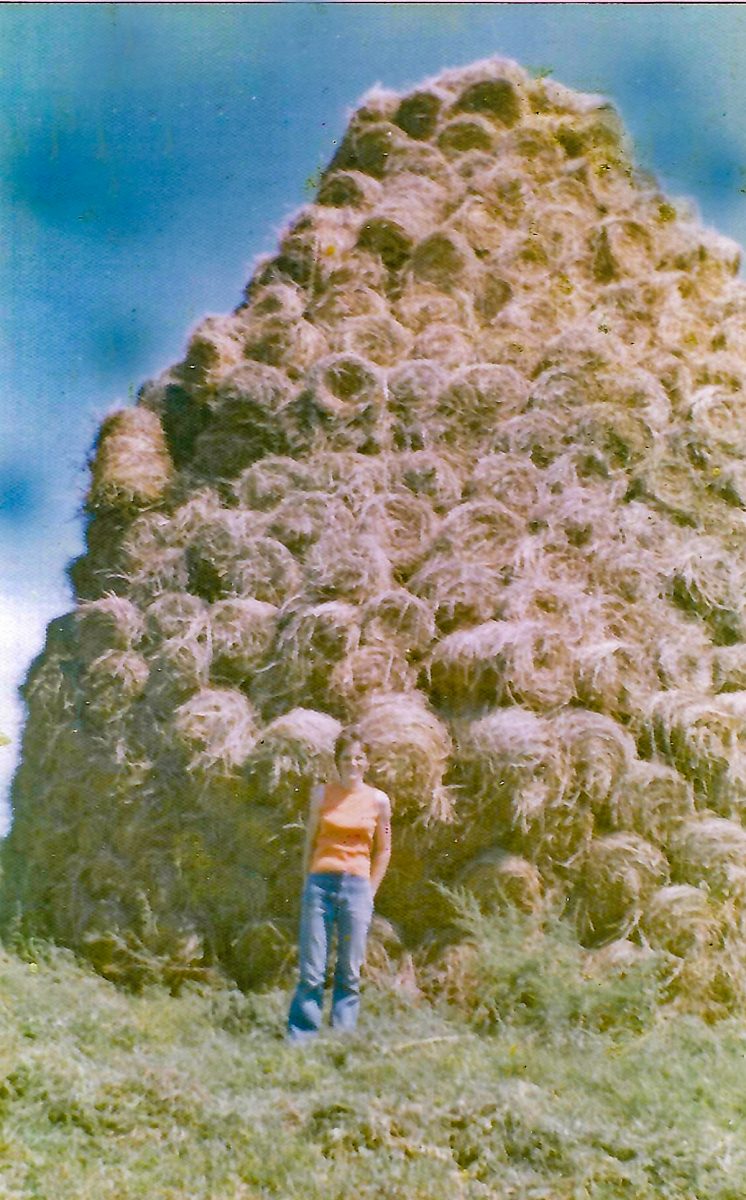
A round bale haystack, circa 1956.
By Beverly Clinkingbeard
Make hay while the sun shines. Strictly speaking, that is a rural adage with little reference in the urban setting, but the meaning, doing something while the opportunity exists, fits rural or urban.
Man has made hay from early days onward. First, manually with a scythe, from the time it was needed for personal comfort, house and shed building and for hungry livestock. Here in Northwest Missouri, it is traditionally HOT when good hay makin’ is in progress.
Once industrialization and the machine age came along, farmers figured out ways of dealing with making hay. A labor-free method is yet to be introduced, but meanwhile, methods have changed and improved.
For years, big barns were built with a big capacity for hay storage. A hayrack and pitchfork were favored methods. Hay stacks that were designed to shed water dotted the fields. Then came the tractor with new ideas of buck rake and a stacker (that resembled an erector set production) and it was either put into a hay stack or put into the barn with the use of pulley, rope and a hay fork. Aspects of that type of haying gave kids an introduction to making hay – sometimes a way of earning some extra money.
The hay baler was a new machine and the initial balers were stationary. Hay was brought to the machine. Later, it would be a pull type, but required a crew of three, a tractor driver and two men to ride on the back and tighten the baling wire. Next, someone had to pick up the bales of hay. The bales were heavy, so someone designed low carts called low boys. Any efficiency also required a crew of three. One to drive the tractor and pull the low boy as close as possible to the bales, and one or two workers on the low boy, to methodically load the bales to haul as many as possible each load. Square bales didn’t shed water so all this needed to be done between rain showers, no matter how hot and miserable the day was. The hay fork didn’t work as well with the square bales, but an elevator was often employed, or some other clever contrivance. (When it comes to labor saving ideas, farmers make super clever, work saving devices and are great inventors.)
As machinery improved, so did balers and Allis Chalmers came out with a baler that made little round bales. They could be left in the field, but rarely were. They weren’t as heavy as the square bales and were designed to shed water, however, the baler itself was often described as a mechanical nightmare. When the hay was fed to the cows, they ate almost every stem and leaf. Arrange them carefully in a hay stack and only the outer hay on the bales was affected by weather.
Once, some old straw bales that had been stored inside were given for garden usage. I unrolled them down the tomato row and the straw was as bright and shiny as the day it was put in the barn. The unused bales were stored beneath a tree, and the next year when they were unrolled, the outer layer was weather affected, but the inside layers still bright and shiny.
But along came another new idea; make a big round bale and that’s where we are today. They dot the fields and along the road. The balers are efficient and bale loaders and carriers are down to a one man operation. The equipment changes, manpower needs change, but the best hay making weather doesn’t change – hasn’t been improved on as it is best, good and hot!
’Til next time. Keep cool.


