


By Beverly Clinkingbeard
It’s been 45 years since our nation’s military officially departed operations in Vietnam.
It’s been 100 years since the establishment of The Tomb of the Unknown Soldier in Arlington National Cemetery, Washington, D.C. Following WWI (the war to end all wars), an unknown soldier from past wars were interred. The tomb has faithfully been guarded by an Honor Guard of the U.S. Army’s 3rd Infantry Regiment (also known as the Old Guard), since October, 1921. Arlington Cemetery was officially established following the Civil War on the property of General and Mrs. Robert E. Lee.
In 1955, the slogan for the U.S. Navy was “Join the Navy and see the world.”
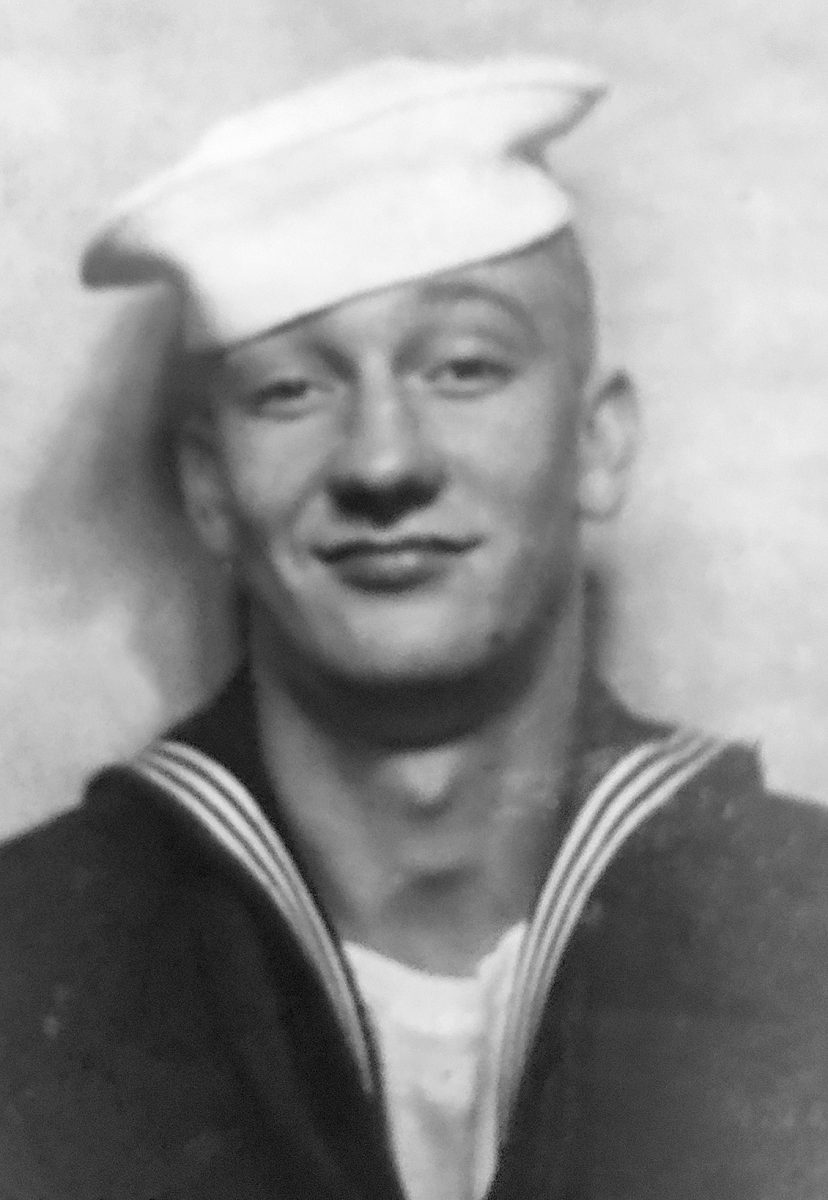
Veteran, Jay Clinkingbeard, tells his story this way. “For a guy recently graduated from Westboro High School, it indeed seemed like a plan to join the Navy and see the world. My older brothers had served in the Navy and the military draft was still in effect. A Navy recruiter was only too happy to sign me on. At the time there was no official armed military action, but there was the “Cold War” – meaning our military stood ready to activate at any time. Communist Russia and China were at a cold stand-off with the United States.
“My parents were Carl and Veda Macrander Clinkingbeard Kerr. They took me to Clearmont, Missouri, where I caught a Trailways bus and met other recruits at the train depot in Kansas City, Missouri. We overnighted to Chicago, Illinois, and from there were bussed to the Great Lakes Naval Training Center for 12 weeks of Boot Camp.
“Boot Camp was an experience. Because I had been in the National Guard (all of four months), along with another recruit, we were in charge of our barracks and training group. That turned out to be a real headache, and once we received a report our barracks were not in order, we determined we’d be the cleanest recruits-in-training at the base. This took some doing, insulting and denigrating moments, but there were no more demotions and our cleanliness set a record.
“After Boot Camp and a short leave at home I took a train to San Francisco, Treasure Island, California. There I was enrolled in a Damage Control course that included firefighting, welding, plumbing and miscellaneous repairs. Little did I realize at the time how very helpful this training would be throughout my life.
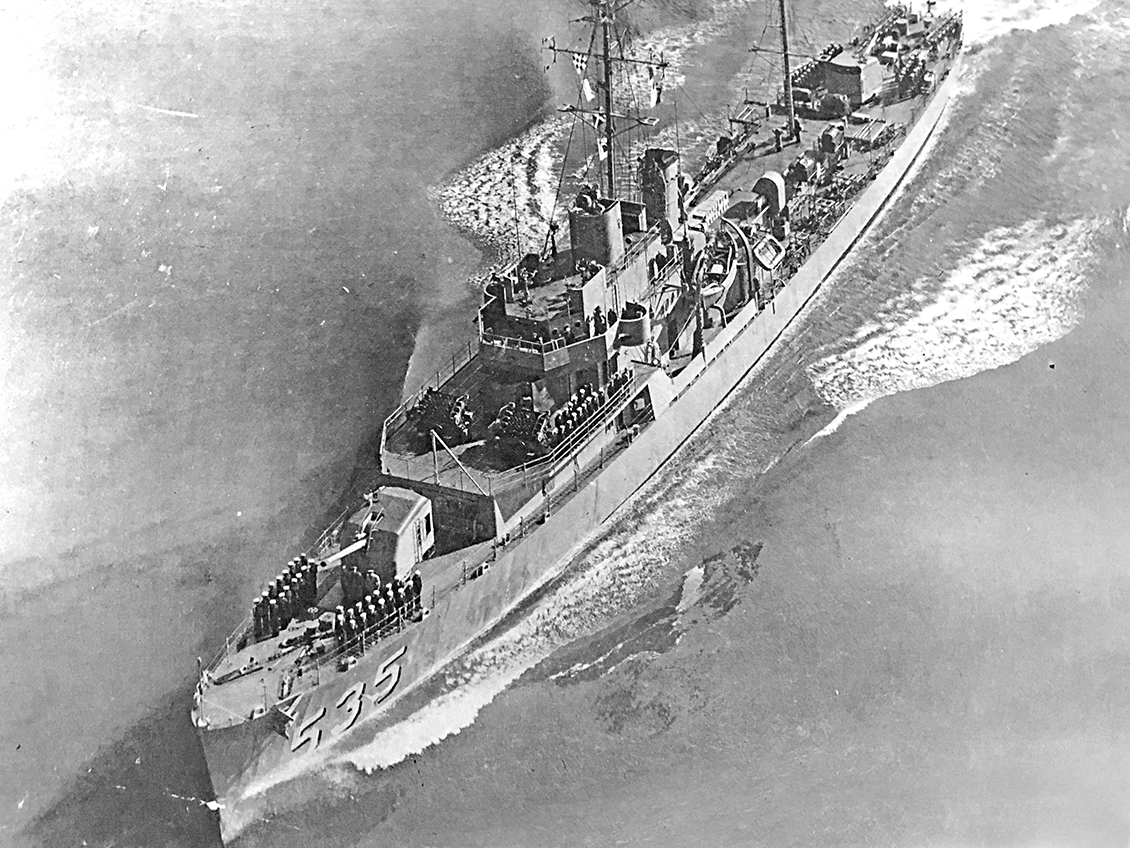
“Twelve weeks later, with a damage control insignia on my sleeve, I had orders to meet a ship at Pier 2 in San Diego, California. On arrival, the ship wasn’t there, so the Navy put me on a freight flight going to Alameda Naval Air Station. One engine conked out (they said not to worry, it always does that). We circled until the fog lifted and I eventually made my way to Mare Island, Vallejo, California, where the USS Lewis DE 535 was in dry dock receiving an upgrade and go-over.
“The Lewis was a small destroyer escort (some yachts are larger than the Lewis) and the duty of the ship was sail on the outskirts of a flotilla of ships. Essentially it was a submarine chaser aimed at protecting the inner ships, especially the troop carriers and aircraft carriers.
“They welcomed me aboard and I had a sling bunk and a place to stow my belongings. Once out of dry dock the war games began and endless maneuvers. The Commodore was aboard the Lewis so we flew the Commodore’s flag too. Our fellow destroyer escort ships were the USS Moore, USS Wiseman and USS Sieverling. My shipboard life was a series of watches – engine room watch, burner watch, fireroom watch and evaporator watch (sea water was turned into potable water for drinking and boilers).
“The ship departed San Diego for Pearl Harbor. From there to Midway, Quadulon and on to Guam, where we operated for several weeks before going to Hong Kong, and from there to Taipei, Formosa. The Formosan Straits are shallow and waters are rough. At the time, Communist Chinese and Nationalist Chinese used armed small junks and would shoot at one another. The arsenal would zing over the ship and we’d sail between them and they’d scurry off to their ports.
“We departed Formosa and sailed to Yakuska, Japan, then to Sasebo, and our next port of call was Subic Bay in the Philippines. We operated out of there until it was finally time to return to San Diego. I took leave and got myself married to Beverly Edwards, my high school sweetheart.
“I returned to San Diego with a wife, and life on the Lewis and war games resumed. Deep Sea Diving School became available and I received an additional patch on my arm. By then it was time to go overseas again. From Pearl Harbor we went to the Marshall Islands with a stop at Quadulene. This trip was an island tour and we crossed the equator. I went from being a “Poly-wog” to a “shell-back.” There is an initiation that goes with this that is to be fun and games. Maybe it was? We steamed on to the Samoan Islands with a stop in Pago Pago. From there to New Zealand, and they welcomed us with open arms. We were the recipients of gratitude for what the “Yanks” had done for them in WWII. They invited us to big feasts and visited our ships drinking bodacious amounts of coffee. They loved the stuff.
“After New Zealand our next stop was Melbourne, Australia and from there on to Sydney and Townsville, Brisbane (nursing school students visited our ship – all girls), then on to Darwin (where the flies were huge). After Darwin we sailed to Borneo and Singapore. There we joined an international operation that included Briton, Australia, Pakistan, France and others. It was a confusing operation, but my job was below deck to keep everything running smoothly.
“We had two catastrophic events during these operations. One was a fire that filled the galley with acrid smoke. I donned protective equipment and discovered an electrical fan that brought air into the lower holds of the ship was burning. The other catastrophe involved taking on fuel. We pulled alongside a tanker ship and a line was brought over. There was a miscommunication and the crude oil was not cut off. It spewed into the galley and other areas of the ship. What a mess! We were a long time getting that cleaned, and since it was the galley, it definitely affected our dining! One of the other ships sent over some canned peaches and we ate lots of spam. “Officer Country” (as we called Officer’s Quarters) was not affected, but I don’t recall they shared any provisions with us. Repairs were made when we pulled alongside the USS Dixie in Sasebo, Japan. Other ports of call were Negros Islands in Mindanao Philippines, and included Princessa, Jolo and Manila. From there, to Subic Bay, Hong Kong, Formosa, Mariannas and Guam.
“We went through several typhoons. The Lewis could take a 60 degree roll without capsizing. We’d batten down the hatches and steam into the storms. In the worst storm, I watched the needle of the gauge hold at an unprecedented 59 degrees. Later, the captain commended the crew for our good work at keeping the ship aright. Our captain was a medal-of- honor recipient from WWII, and we all had the utmost respect for him.
“When visiting the Mariana and Marshall Islands my job was to man a rubber raft. Passengers included an engineering officer, a corpsman (who dispensed medical supplies, pulled teeth, bandaged wounds, etc.) and a signalman. At these islands we would leave first aid and health items. The Islanders always welcomed us, and once again we received the appreciation of the “Yanks” who had helped them in WWII. They would drop us off and the ship steam on to other islands. They would pick us up later at a designated time. All went well until our engine quit. The waters were shark infested and darkness descended. We could see the ship in the far distance, and shot off several flares. However, they were looking for us toward the island and we had floated out to sea. Our last flare was shot off, and fortunately, someone saw it. We rowed mightily toward the ship.
“After coming back to San Diego I was transferred to the USS Taussig, DD736. We escorted the aircraft carrier USS Bennington to Pearl Harbor. The marines were practicing landings and takeoffs. Unfortunately, five ended up in the drink. Two were rescued alive. The others we picked up pieces. It was a sad time.
“The Taussig sailed to Guam, the Philippines, Subic Bay and Manila and Hong Kong. My time with the Navy was about up and they transferred me to the USS Twining. I enjoyed the Navy, loved being out to sea and gazing at the night sky holding a jillion stars, and would have liked to make it a career, but my rate was what they called “frozen” because WWII and Korean War sailors were still serving.
“Over the years I have come to appreciate the lessons and life skills I received, albeit most times unknowingly and unwillingly. I am in touch with former sailors who also served aboard the Lewis. Until Covid, we met once a year for a reunion and swapped stories. It is interesting the different directions our lives took.
“I joined the Navy. I saw the world. I got as much or more than I gave.”


