


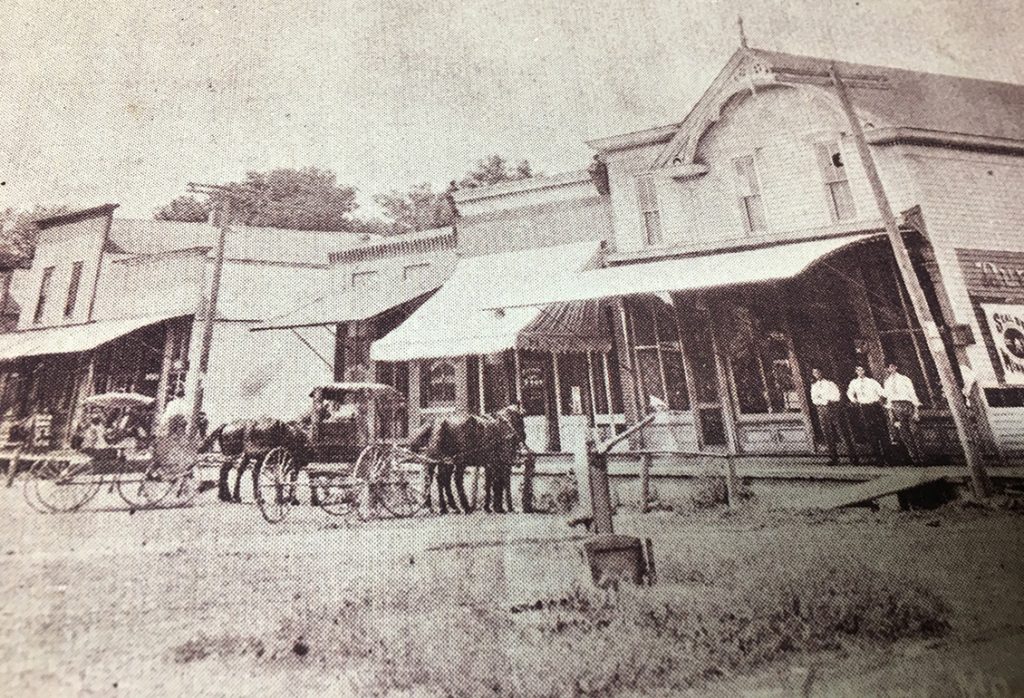
Submitted by Beverly Clinkingbeard
Those who remember Tucker’s Store of Westboro, Missouri, would like nothing more than to open the door, breathe in the scent of leather, cloth, groceries, and so much more. But the shopping experience would need to have Scott or Martha standing behind the counter, pencil poised over a pad to itemize purchases. (Scott’s writing is illegible, but so what? We know what was purchased.) A rip of brown paper off the big roll at the end of the counter to wrap and tie it securely with string that dangled from a big spool above the counter. With a thank you we’re out the door handily carrying our package by the strings.
A.R. Tucker’s name first appears in the Westboro newspaper column in 1913. It simply said, “A.R. Tucker is spending the week with his family at Clarence.” A.R.’s granddaughter, Martha Ann, explained that Tucker’s were originally from Clarence, Missouri, and her grandfather, A.R., was looking for a mercantile business to invest in. A store owned by Webb was available in Westboro and it seemed a promising situation. Initially the store was known as Tucker Stuart & Co., then under full ownership, Tucker’s Store, also advertised as Tucker’s Mercantile Co. Until A.R. could have a house ready for his family he stayed at Lester Tourtelotte’s.
The Tuckers knew merchandising and how to operate a store that catered to the needs of folks at the time. A.R.’s son, Scott, had graduated from high school in Clarence and worked at the store of Stuart & Tucker in Clarence. He would join his father in the Westboro store business.
The store, located on the corner of Main & Adams Street, was a two-story building with a canopy over the front. Typical of stores then, the door and display windows were made of steel and pre-formed to insert at the time of construction. It is stated elsewhere the little store building at Center Grove was added onto the building. This must have been at the rear of the store. There was a door open to Main Street and a side door entry on Adams Street to the east. (The store from Center Grove, once called Center Point, closed when the railroad made it through Westboro and shopping trends changed and settlers arrived.)
Ethel Uttvit Bargman (1889-1987) wrote, “At one time we had 4 passenger trains and 2 freight trains daily. At one time we had 3 hotels and 1 boarding house, 2 churches, 2 barber shops, 2 banks, 3 drug stores, 2 hardware stores and harness shops – 1 frame school house destroyed by cyclone and 1 frame school house torn down and 1 brick face school house with a gymnasium added.” Bargman was a life-long resident of Westboro. There were also the produce and feed stores, milliners, wagon makers, blacksmiths, doctors, and other businesses as well.
A.R.’s son, Scott, lived on the second floor of the store. If the single girls of Westboro thought an eligible bachelor had moved to town, he was indeed a bachelor, but not eligible.
Martha Scipes was experienced in merchandising, having worked at Stix Bear Fuller Department Store in St. Louis, Missouri. She became ill with the flu and lost her job. As a side note, Martha’s daughter, also Martha Ann, remembered her mother’s roommate cared for Martha, who also lost her job. They remained life-long friends. The friend moved to California and worked in the movie industry making hats. Martha moved home and worked in a milliner’s shop.
Scott would return to Clarence and marry Martha Ann Scipes at her family home in Slater, Missouri, February 11, 1919. They settled in a small home on First Street located next to the Westboro Methodist Church, and later moved across the street to a larger house (located beside what is now the Methodist Church parking area).
Martha worked in the store alongside Scott. A single aisle went from the front door down the center of the store. They sectioned the store off into open departments. On the east side wall were shoes and boots. A ladder on a rail allowed the merchandise to be stacked beyond reach. Tables held various sizes of men’s clothing, especially the overalls that farmers typically wore. When blue jeans became popular there were tables of folded blue jeans. Hats, socks, gloves, coats – Tucker’s had it all. On the west side of the store were the ladies dresses, aprons, unmentionables, stockings, sewing notions and bolts of fabric. There was furniture upstairs, and what wasn’t in stock, could be ordered. Groceries were a big part of their business. As electricity became available they had cold storage for ice cream and other items.
Scott and Martha had two children, Robert and Martha Ann. Rosa Kahle lived across the street from the Tuckers in a small home. She worked for the Tuckers keeping house and child care while Martha worked at the store. Of her, Martha Ann said, “She worked for my parents for 50 years, was a good cook and a wonderful person.”
In the early years the store took in chicken and eggs on the basis of merchandise trade, however, with Uttvit’s produce store next door (later Herrick’s) they ceased bothering with poultry. When Martha had diphtheria Scott moved to his former abode on the second story of the store and Rosa Kahle nursed Martha and cared for the children. Business went on. Everyone depended on Tucker’s Store to be open and stocked.
In retrospect remembrances, school children found Tucker’s to be patient with their penny purchases of candy or gum. When with their parents there was always a free piece of candy. The store kept accounts for people and shoppers could say, “Put’er on the bill” and walk out. A hand written ticket was made for each purchase. Another recall was shortly after marriage a young man watched someone “put it on the bill.” He asked Scott, “Could I do that too?” Scott assured him he could and at payday he could settle up. He said, “That was my first business transaction and at payday my first stop was to pay my bill.”
Another remembrance is a family lost everything in a house fire. They sat in the opera seats in the shoe department and Scott measured for the proper size. The sneakers were free of charge, and the family never forgot.
The big shopping events were Wednesday and Saturday nights. There was an era when everyone went to town on Saturday night. People shopped in leisure and visited between times. When they had finally gathered what they wanted, and settled the usual news, they were ready for their purchases to be itemized. If an item wasn’t in stock, it would be ordered. In addition to Martha working at the store there were several helpers remembered: Mary Shorty Macrander, Mary Todd Macrander, Mary Petry, and Martha Ann, their daughter, clerked during her high school years.
After the bombing of Pearl Harbor it was unknown if the enemy could penetrate farther than the islands (that many had never heard of). With civil defense leadership, men gathered at Tucker’s Store to discuss the situation. For a time there were guard postings. In all manner of community affairs, the Tucker’s were supporters of the school and church. In addition to the store, there was Tucker’s Funeral Service, but that’s another story.
In 1962, Tucker’s celebrated 48 years of being in business with an open house. Two hundred people attended. But with all good things, Scott and Martha were aging out, and eventually it was time for a change. In 1964, the store was sold and several owners followed – Shorty and Clara Irvin, Sonny Hopkins, Shiek and Vera May Clement and Jim and Regina Quimby. Eventually the building was sold again and demolished; a modern storage building erected in its place. Martha died in 1969 and Scott in 1982. They rest among their friends and patrons in Center Grove Cemetery south of Westboro.
’Til next time…


