


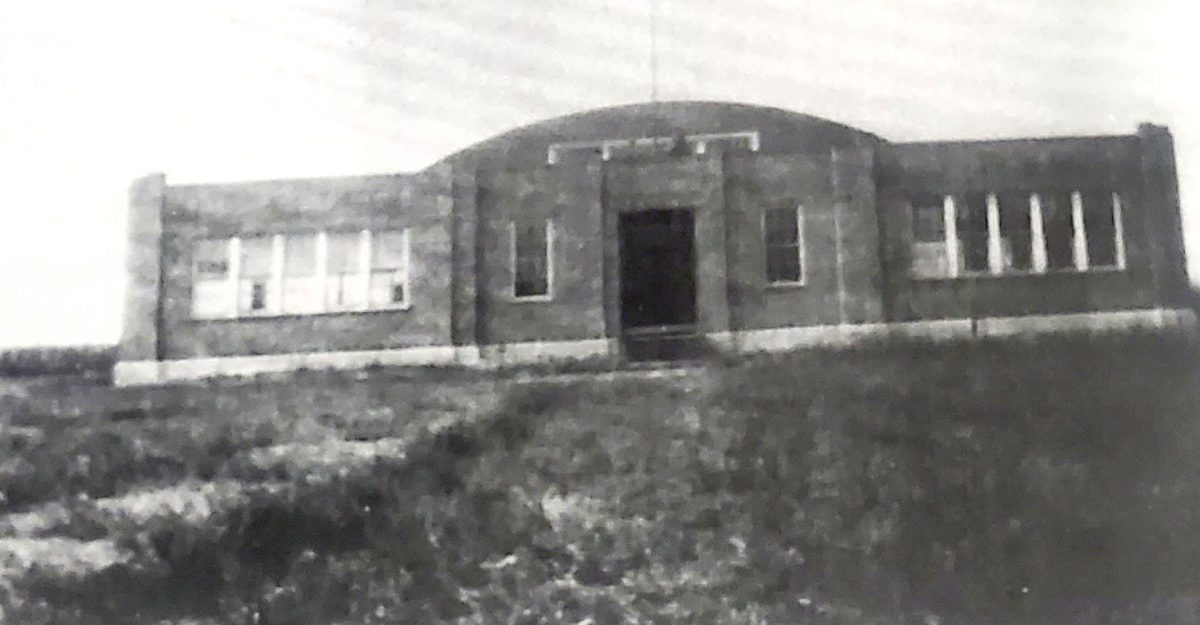
The Nishnabotna School.
By Matthew Barnes
Following the success of the consolidated high schools at Daleview and Irish Grove, citizens in the Nishnabotna vicinity decided their students deserved better. A petition was started in 1921 to consolidate the Nishnabotna, Cooper, Valley View, and Lincoln districts. Due to objections in the Cooper district, it was removed from the proposed district. The election to form the new district was held on December 28, 1921, and passed overwhelmingly with 88 voting for and 36 against.
An election was held on January 17, 1922, to elect the first directors. The first board consisted of P.E. Hoffman, N.J. Ray, Ben Walker, Clyde Jennings, Irwin Beasing, and Marion Holliway. The board’s first priority was to construct a modern high school building. An election was held in 1922 to vote on bonds of $13,500 and passed by a narrow margin. A point of contention was where the new school was to be located. The country folks wanted the new school to be centrally located on higher ground, while the residents of Nishnabotna, a small town of 20 on the Missouri River bottom wanted the new school located in town. The citizens of the town won out, with the concession that the rural schools remain open.
An architect was hired and designed a school building greatly exceeding their resources. The building was originally to include a 53’ x 63’ community hall, six classrooms, an office, and a furnace room but due to a lack of funds, the final building only contained four classrooms instead of six. The contract was awarded on January 22, 1923, to Charles Norris of St Joesph. When the money from the bonds was depleted, the building still needed roughly $9,000 to be finished. Believing that there was community support to see the building finished, and wanting to see the high school open in time for the 1923-1924 school year, the board went ahead and borrowed the $9,000 before the bonds were approved. The bond issue failed with 73 voting for and 83 against. There were five more attempts at passing the bonds of lower amounts over the course of the next year, all performing worse than the first. There was reported quite a lot of friction in the community. The sheriff had to be stationed at the polls after there were several altercations outside the polling place.
No additional bonds were ever passed, which left the board personally responsible for the money which had been spent. As a result, the school building was never completely finished. By the fall of 1923, the floor had not been completely laid, and without the proper equipment, the high school did not open until the following year. Like Centennial, Nishnabotna was far too small in area, valuation, and population to effectively support a high school.
The high school opened in the fall of 1924 with John F. Uhlig as the superintendent and the only teacher that year. The old Nishnabotna schoolhouse was sold in May 1925 and Sylvia Sutherland was hired as a second high school teacher. A state inspector granted the district status as a third-class high school for the 1925-1926 school year – a great disappointment to the citizens of the district. The reason is the lack of adequate equipment, again due to the lack of funds. The enrollment that year was 13.
Guy Canady was hired as superintendent in 1927 with Wilson Craig as principal and Mrs. Guy Canady as a high school teacher. The school was raised to second class that year with an enrollment of 26 in the high school and 92 in grades 1-8. The following year the school finally achieved first-class status. The enrollment at that time was 106 in the elementary grades and 26 in the high school. This was the high mark for enrollment. That same year Nishnabotna graduated its first senior class, which consisted of Donald Ray, Enon Brooks, and Charles Brooks.
In 1929, Homer Williams succeeded Mr. Canady as superintendent, and the enrollment fell by 30 students that year calling into question the feasibility of the school. High turnover was a frequent issue due to the fact that Nishnabotna did not have the resources to compete with surrounding districts with regard to salary. Mr. Archie Bridges of Uhlig, Nebraska, was hired as superintendent in 1931, and neither he nor the rest of the salary would remain two years later.
The depression proved difficult for the small district. One high school teacher was eliminated in 1934, and the school was reduced to a second-class high school that same year. This was due to the fact that the school could not afford new materials.
These hard times were made worse when Valley View school burned in 1933. The district had insurance for $950 but that was not enough to cover the construction of a new school so therefore its future was uncertain. Despite the tough economic times, patrons of the district approved a slight tax increase that year to build and equip a new Valley View school. Mr. Bridges assumed the superintendency at Chilhowee, Missouri, in 1934 and was succeeded by Clair Wulbur of Tarkio. That year the enrollment fell to 14 in the high school and 88 in the grades. Mr. Wulbur’s tenure is considered the golden age of the Nishnabotna basketball program.
Nishnabotna had fielded a basketball team since the school’s inception in 1924. The first year the school barely had enough boys to field a team and Superintendent Uhlig served as the first coach. A girls’ team had also been organized by 1929. Games were held in the large community hall. While the school mascot is unknown, it is believed that the crude early-day uniforms were blue and white. The first Nishnabotna basketball tournament was held in 1929. The teams participating that year were Belleview, Corning, Craig, Daleview, Watson, and Westboro. Daleview won the boys’ tournament, and Nishnabotna won the girls’ tournament.
Clair Wulbur and the 1935 Nishnabotna boys’ basketball team only lost two games, and during the late thirties the Nishna boys would regularly find themselves competing in the finals of tournaments all over the region. Later, when Mr. Wulbur was superintendent/coach at Avoca, Nebraska, his team won the district title three years in a row.
Nishnabotna High School was once again raised to the first class in 1937, however, the enrollment continued to decline and remained a dire concern. In 1939, Mr. Wulbur accepted the superintendent job at Avoca, Nebraska. The 1939-40 school year had the distinction of a completely new teaching staff at NHS. Glen Redford was hired as superintendent with Miss Cook and Miss Mercer serving as teachers. The enrollment rebounded that year, rising from 14 to 21.
The institution of the draft in 1940 as a response to the outbreak of World War II led to a teacher shortage. Both Miss Cook and Miss Mercer left at the close of the 1939-1940 school year, and as the start of the fall term grew near, the district was unable to find qualified teachers. Finally, in August, the district hired Raymond Mitchell, brother of former elementary teacher Merrill Mitchell to teach social studies, commerce, math, and to coach basketball.
Superintendent Redford was drafted in the spring of 1941 and Raymond Mitchell assumed the role of superintendent. Helen Brown was hired at that time as a high school teacher. Nishnabotna started a hot lunch program with parents contributing produce, meat, and canned goods. The mothers took turns preparing the food.
Mr. Mitchell was drafted in January of 1942 and Randolph Green, retired superintendent of Irish Grove School, finished out the last semester. At that time the Nishnabotna C-6 school board made the difficult decision to discontinue the high school, citing a decline in enrollment and the ever-rising operational costs. Lincoln school was closed at that time and the central high school building was used as an elementary school, employing two teachers as well as continuing to operate Valley View. Darlene Schmidt, who attended Valley View during its last year of operation (1947-1948), said that the teacher at that time was Alice Brown, who lived in the basement of the school.
Unable to afford a school bus, Darlene recalls walking to school. “Early in the spring when the ground thawed the mud was so deep it was nearly impossible to walk to school,” Schmidt said. “Dad would take me to school on our horse. The only saddle was a burlap sack.” Following Valley View’s closure, it was moved into Rock Port where it was converted into a house that still stands on Rainbow Drive.
Still unable to afford the school bus, students from the rural areas of the district had to find creative ways to get to school. One of those forms of transportation was Lee Slemp’s car which all of the neighborhood children would pile into, well exceeding its capacity.
When recess wasn’t held on the modest playground, it was held in the school’s great room. Darlene recalls playing “ crack the whip” and tag in the gym. While she cannot remember what they were playing, she recalls having rope burns on her neck following recess, much to her mother’s horror!
The school went through the flood of 1952, with water reaching four feet in depth within the school. At the July 1952 school board meeting plans were made to repair and equip the school for the upcoming school year. The Fairfax fire department and community members removed the mud deposits from the school. The school had made preparations to repair the roof prior to the flood. The barrel of roofing tar had been deposited on the Campbell farm. This was retrieved and the roof was repaired. The school grounds were mowed and new outhouses were installed. The school desks had been destroyed by the flood and second-hand desks were purchased from the Fairfax school to replace them. After many hours of work, school began on time.
A reorganization election was held in 1951 that would have included Nishnabtona C-6 in the Rock Port R-II district. Nishnabtona voters voted against the proposal fearing their school would be closed. While the proposition failed, it was proposed again two years later. Following the flood, Nishnabotna was facing financial difficulties due to less tax revenue. As a result, voters in the Nishnabotna district voted for reorganization overwhelmingly. Thus, Nishnabotna C-6 ceased to exist and the district was incorporated into Rock Port R-II. Rock Port continued to utilize the school as an elementary school for grades 1-6 under the supervision of one teacher. In 1961, the Rock Port R-II district began the process of restructuring. A recent addition to the Rock Port school made the Nishnabotna school obsolete and the school was closed at the end of the 1960-61 school year after 37 years of operation.
On a cold, rainy spring night in 1967, an alarm was sounded. Two houses and the old Nishna schoolhouse were on fire. As the Fairfax, Rock Port, and Craig fire departments rushed to the scene, members of the community gathered to watch the building that held so many dear memories burn. “The sky looked like it was on fire,” Darlene Schmidt said. “We drove into the Sly place to watch the old school burn. That was the most people I had ever seen in Nishnabotna,” she stated.
The Nishnabotna school signified a desire of a community to offer their kids a better education. While they hit many obstacles in the process, and things didn’t quite go as planned, hundreds of students received a high-quality education down at Nishnabotna School.
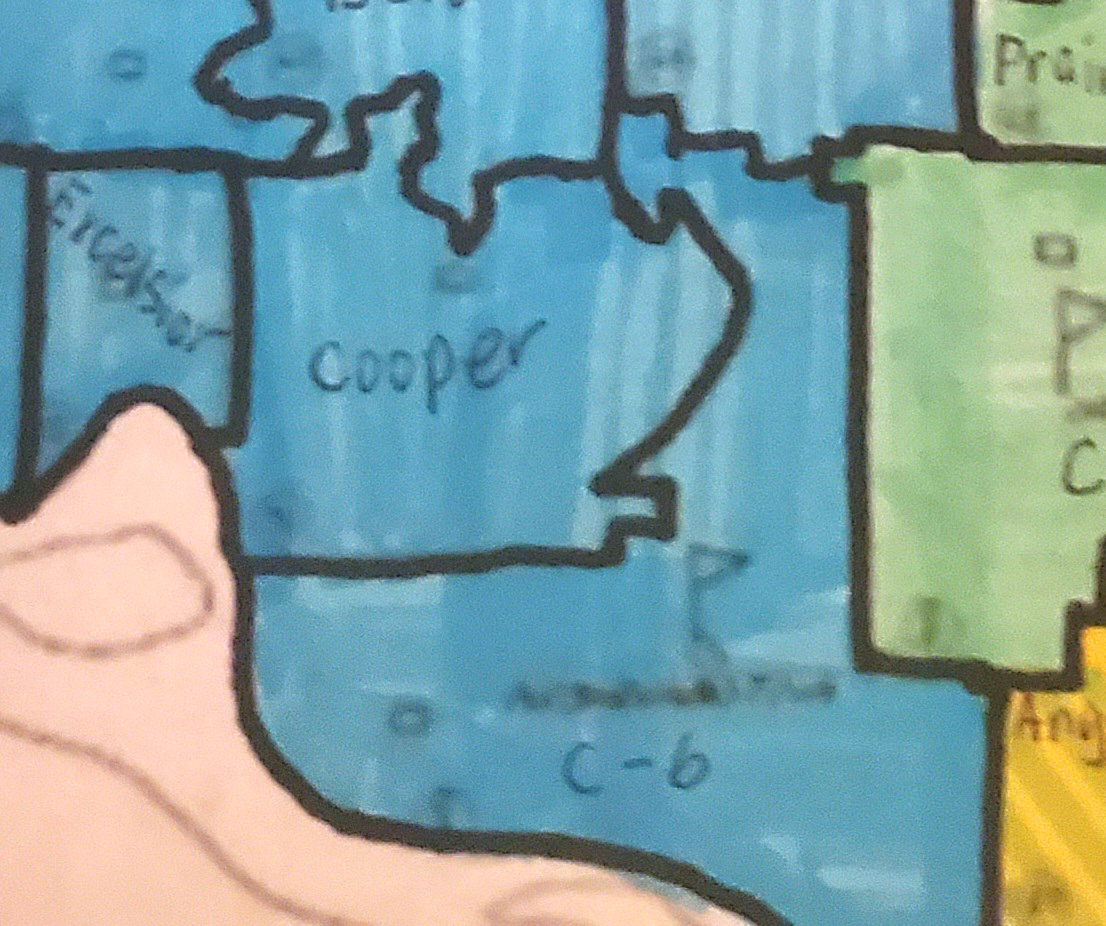
The Nishnabotna C-6 School boundaries.


