


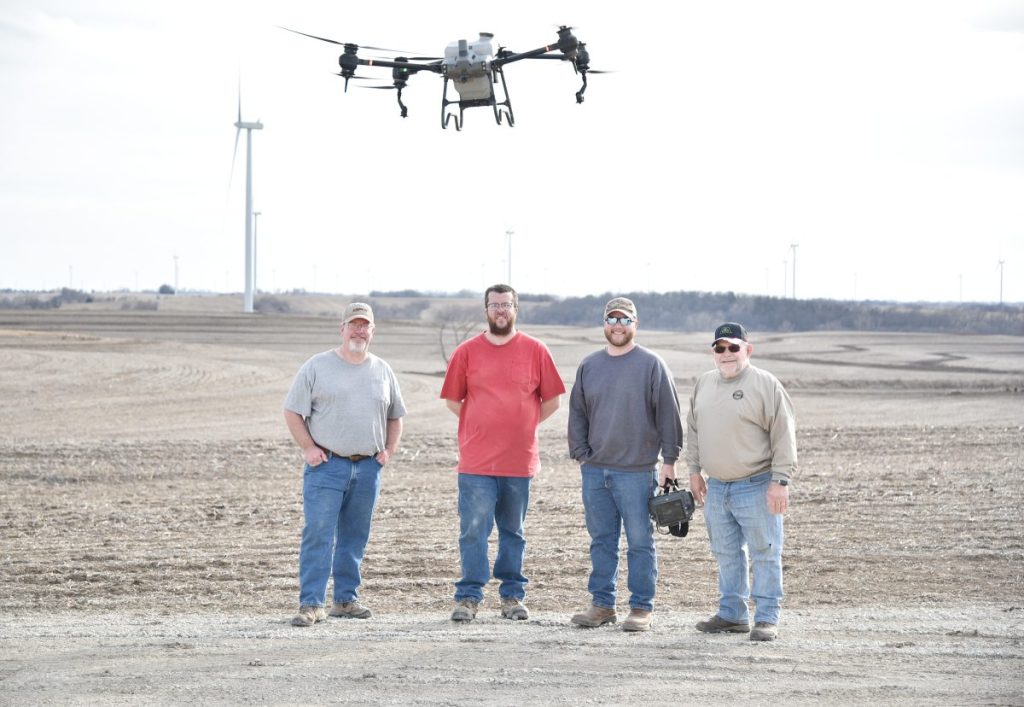
Steve, Zach, Paul, and Duane Klute with Klute Farms held a drone field spraying demonstration east of Westboro, Missouri, Wednesday, February 21, 2024. The Klutes purchased the DJI T40 spray drone to spot spray their own fields, as well as the fields of other area farmers.
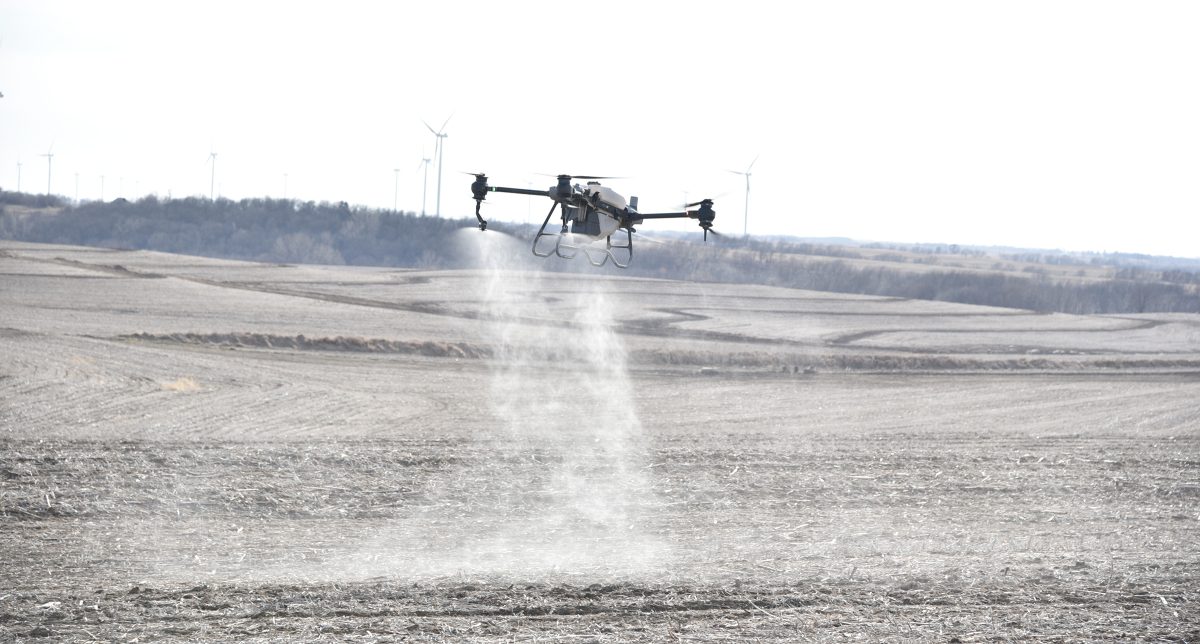
The drone – named “Matilda” – uses a 10 gallon tank and a 100 pound spreader and can spray about 30 acres per hour. It is battery operated with batteries lasting around 10-15 minutes.
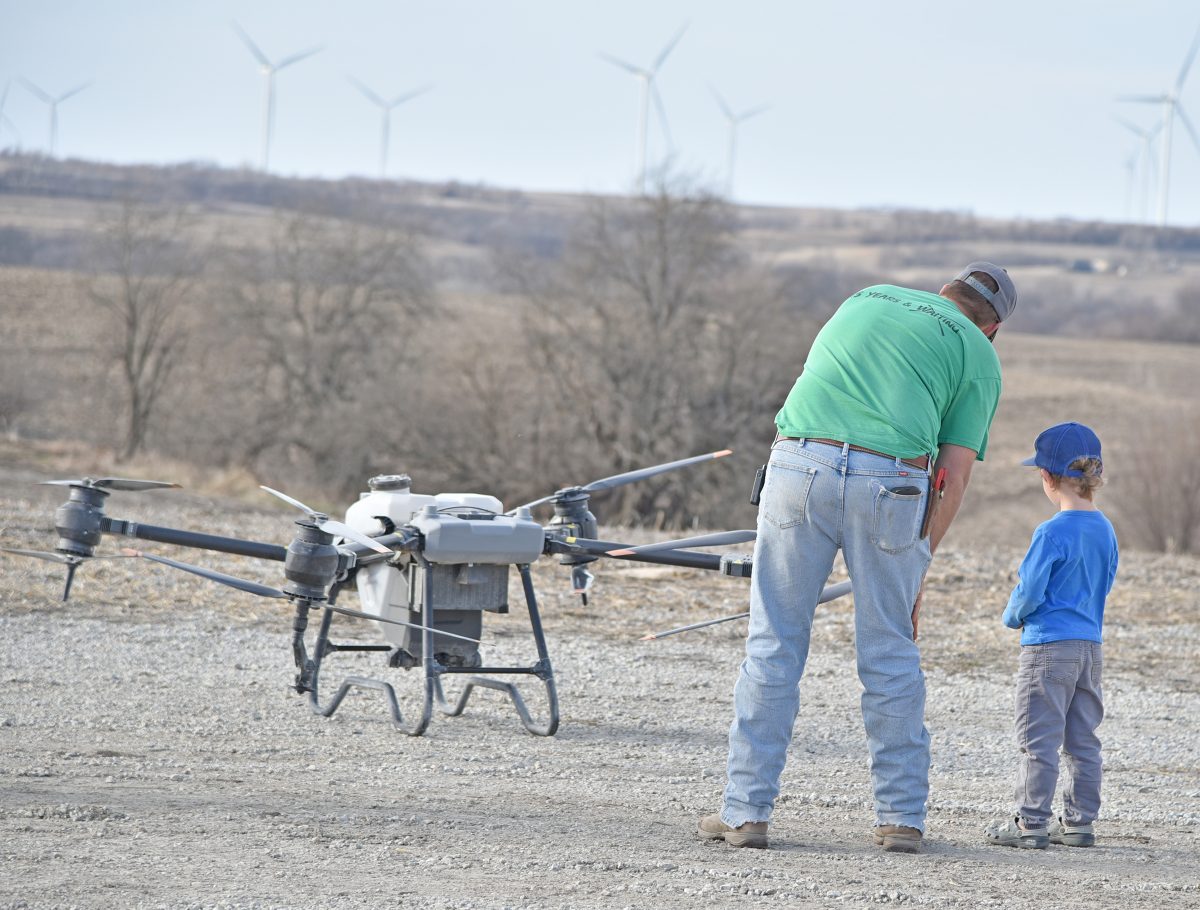
Spencer Barnes brought his young song, Lannie, to the drone spraying demonstration. Farming, the equipment, and use of technology has changed tremendously over the centuries and it will be interesting to see what gadgets will be used when Lannie’s generation becomes farmers.
The operation of farming and the animals, equipment, and technology used to make it a success has evolved drastically over the years. What farmers used to do by hand centuries ago is now done by mega machinery and flying drones that vastly reduce the man hours needed as well as greatly increases the efficiency of the successful growing of the crops themselves.
One local farm family recently purchased a DJI T40 spray drone to spot spray their own fields, as well as the fields of other area farmers. To show what the drone can do, the Klutes, including Duane, Steve, Paul, and Zach, held a demonstration on their farm east of Westboro, Missouri, Wednesday, February 21, 2024. Around 15 farmers and agricultural representatives were on hand to see how the drone operates.
The drone – named “Matilda” – uses a 10 gallon tank and a 100 pound spreader and can spray about 30 acres per hour. It is battery operated with batteries lasting around 10-15 minutes. However, it comes with an ultra-fast charging station that provides a quick full charge for the batteries. Although it’s not a perfect method to spray a huge amount of acreage, it is very efficient in spot spraying smaller areas of fields, especially when it is impossible or difficult for large machinery to get in and around. Vehicle sprayers must drive over crops and can’t get under certain obstacles such as trees. They also get stuck in the mud after a heavy rain. Airplane sprayers can’t spray around wind turbines or power lines. This is where the drone comes in handy. Not to mention that due to its smaller capacity for holding chemicals, chemicals needed are not going to waste as there’s not a huge batch made for just a tiny area. Flying about 10 feet above ground, the drone is able to get the chemicals directly onto the fields and crops, versus having wind catch and spread the chemicals sprayed. The drone moves up and down as the terrain changes and for deep terraces or crevices, the drone can detect the change and adjust to a higher level of flying to make do. It can also detect trees and other obstacles and will stop before a collision occurs with the active phased array radar incorporated with a binocular vision sensor system that provides 360 degrees of view. The drones can also be used for surveying and mapping. The drones do have to be able to connect to the internet (a farmer could use a hot spot on his cell phone to hook up to the drone), but once programmed, it can do the work basically on its own. The drone has dual atomization for even spraying and the magnetic drive impeller pump isolates the pesticide from the motor, making the aircraft corrosion-proof and ultra-durable. It also provides for easy disassembly and cleaning. Steve Klute said drones aren’t necessarily better than airplanes or vehicle sprayers, it’s just a different way of farming, one that has advantages and disadvantages like everything else.
Spray drone flying is not for everyone. Pilots must get certification and learn how to handle the drone and what all it can do. Paul Klute is the pilot of the Klutes’ drone. Paul had to pass the pilot certification exam from the FAA and get exemptions to operate a large agricultural drone. It took about a month to get certified and to familiarize himself with the drone and remote control capabilities.
If you are interested in learning more about the drone, or would like to hire the Klutes to spray your fields using their drone, give Steve a call at 660-744-4079.


