


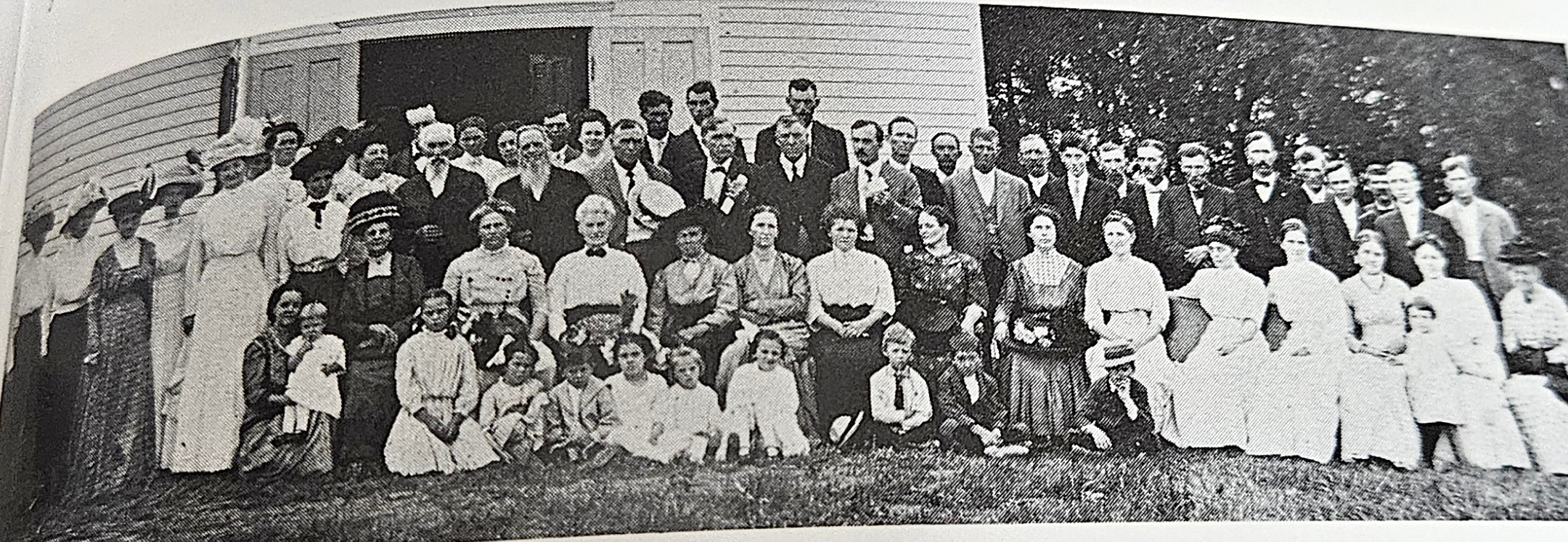
The congregation of Bethany Baptist church in 1911.
Submitted by Matthew Barnes
The Reverend C.L. Butts, a Baptist Missionary in Northwest Missouri, conducted a revival at the Wade schoolhouse, southeast of Tarkio, in November of 1882. The revival moved area settlers and saw the conversion of 11 individuals, leading the pioneers to recognize the need for a Baptist church to serve the community.
On the night of December 9, 1882, the congregation of the Bethany Baptist Church was chartered. Rev. R.M. Rhoades was appointed the first pastor on May 1, 1883, with a salary of $100 per month. A church site was soon selected west of Wade Schoolhouse, at what is today the intersection of Highway TT and S Avenue. The church was to be a framed structure measuring 28’x42’. Plans entailed large arched windows on the east and west faces, as well as large double doors and a vestibule on the south wall. The interior was to feature pine hardwood floors, a barrel ceiling lined with stamped tin, and arched entryways into what are thought to have been cloakrooms.
Construction began in 1884, with the congregation members doing the majority of the work. The new church was dedicated on Saturday, June 13, 1885, with a large crowd attending. Rev. Rhoades delivered the first sermon from the pulpit, followed by a potluck.
A Sunday School and women’s group were organized shortly after the church’s inception, and membership quickly rose, with a reported 52 congregation members in 1890. Rev. Rhoades continuously served the congregation until 1903, aside from a short hiatus in 1898 when Ambrose Hunt assumed the role. C.A. Waters replaced Rev. Rhoades in 1903 and continued to serve the congregation until April 1904. In September 1904, Rev. Thomas Jefferson Puckett was called to serve. Under Rev. Puckett, the church saw its climax of membership with an estimated membership of 90.
Rev. Puckett retired in 1916, and the church began sharing the services of Rev. E.L. Hull of the Fairfax Baptist Church. Bethany began to see a decline in attendance around this time, mostly due to better transportation and population decline. Rev. William H. Leyburn assumed the role of preacher in February of 1919 but left eight months later. At that time, Rev. Thomas M. Grimmett was selected as preacher of Fairfax and Bethany. He continued to serve in this role until October of 1922, when he ceased to serve the Bethany congregation regularly and assumed the duties at Walkup Grove in addition to Fairfax.
Due to the continued decline in attendance, the congregation elected not to replace Rev. Grimmett. Sunday school and morning services continued for a time, but those seem to have ceased by 1926. A meeting was called on January 1, 1928, at the Margaret Holbrook home to discuss the disbursement of the church and its assets. Those in attendance were Rev. T.M. Grimmett of the Fairfax Baptist Church, Rev. D.H. Howerton of the Northwest Baptist Association, Rev. Kennedy of the Tarkio Baptist Church, Margaret Holbrook, Eva Holbrook, Joseph Grush, and H.A. Fullerton. It was decided that the piano would be given to the Tarkio Baptist Church and that the Sunday school tables and chairs would be given to the Fairfax Baptist Church. The remaining assets were to be sold with the proceeds donated to missionary projects in Atchison, Holt, and Nodaway counties.
Frank Bradfield purchased the church at an auction in February of 1928 for $300 with plans to move the church to his farm and convert it into a house to replace one that had burnt the previous year. Mr. Bradfield’s farm was located two miles southwest of the church site. With the help of Dave Barnett, the church was lifted off of its foundation and placed on skids. Then, using a team of 20 mules, the church was moved south on S Avenue to 250th Street. While turning the corner, the church slipped on the skids, crushing one mule and injuring Mr. Bradfield’s shoulder.
Upon regrouping, the church continued to move west to Long Branch Creek. Large beams were placed over the creek, and the team of mules moved to the other side. The skids were lifted onto the beams using jacks and then pulled across using extended leads. The church continued another quarter mile west, where it turned south off of the road onto Mr. Bradfield’s farm, where it was set upon a new foundation.
Remodeling began immediately; the front doors and vestibule were removed from the south side of the church. Doors were installed on the east and west walls, and the arched windows were replaced with smaller square ones. A second floor was installed, and the first floor was partitioned into a kitchen, dining room, two bedrooms, and a bathroom. Plans entailed converting the second floor into three bedrooms, but this never happened as the barrel ceiling remained well into the 90s. Since that time, the church has served as a home to many families, with the current residents, Doug and Jutta Slemp, having resided there since 1979. The structure will celebrate its 140th birthday this June.


