


By Beverly Clinkingbeard
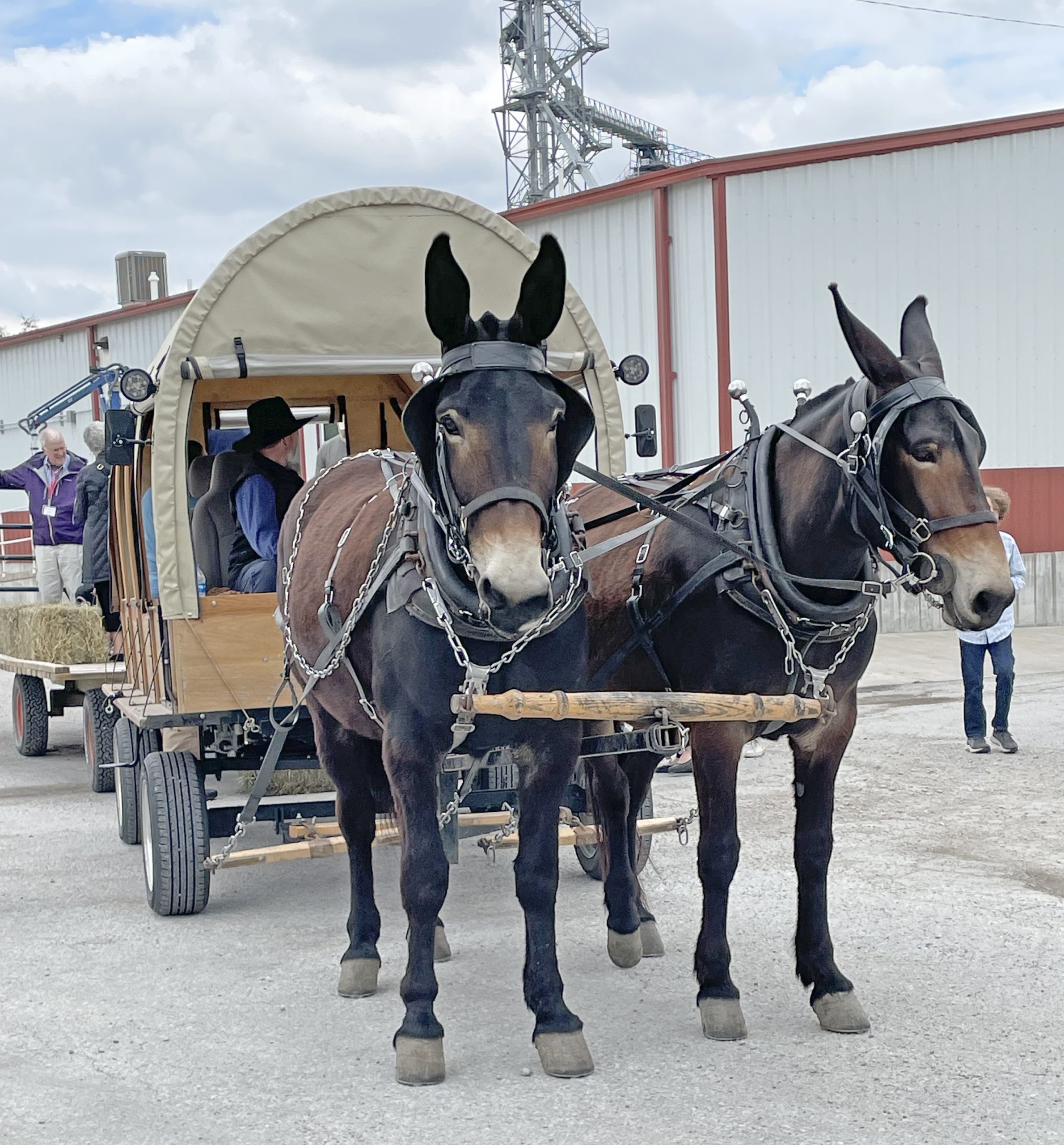
The Tarkio Tech “Tarkiesta” observance and parade was a reminder of the pace of living in times past. As the mule drawn wagon and trailer (a difference being rubber tires rather than wooden spokes) steadily made their way up Main Street, it was a realization that our great-grandparents lived in a different time element and plan to everyday life. With a canvas covered wagon, the perils of the Oregon Trail comes to mind, but there were daily ventures shorter in duration and drama, all dependent on the hitch of horsepower/mule/oxen.
In 1870, the census for Atchison County counted as 8,440 people, a doubling since 1860. The 1880 census reported 14,270 population and 2,165 farms. It was an agrarian county and apparently not uncommon to see white topped wagons making their way through Atchison County pulled by oxen, or a team of horses or mules. Highway 136 was a well-traveled trail. There was a ferry at Brownville to cross the Missouri River and a ferry at the Nishnabotna River.
A news note in September of 1880 was, “The exodus from Kansas continues. There has been almost a continual stream of eastward bound wagons for the last month or two.” What had happened in Kansas that had people going east rather than west? Was it the cloud of locusts that had descended on the prairie in 1874 and the continued drought and hatching of more locusts? Land speculators and sales had promised many things, but not locusts.
The roads and trails were rutted, sometimes muddy, and made travel difficult. Trails tended to range on high ground and circle the bogs. Creeks were navigated at the best places and in 1880 did not have the deep ditches of today that dredging and straightening of rivers for flood prevention has produced. In November of 1880, Atchison County let contracts to build bridges throughout the county. Little Tarkio would have bridges, Long Branch, Schubert Branch and High Creek, with others to follow.
Another unique entry in the news was, “Married: On September 5th, 1880, in their buggy on the public road near the residence of, and by Stephen Soth, J.P. Mr. Walter Lewis, and Miss Etta McKissick, both of Fremont County.” Wonder what the story behind that is? Or, was it merely a matter of catching Mr. Soth, the Justice of the Peace, where he was on the road?
In some ways, old newspapers are a disappointing read. Editors were often political and they would subscribe to a news source and receive preprinted pages and columns of re-hashed political views, then add their own news and opinions. With communication what it was, travel what it was, limitation of space, news editors did manage to preserve a chunk of yesterday for us today.
In 1880, Tarkio had a small cluster of buildings. They, too, had lots for sale and the suggestion, “When you visit Tarkio do not fail to call at the ‘Northwestern’ and get a good meal served as the European plan.” Anyone know what the “European Plan” would be? Could it be the food itself? Or, is it what we might call family style with bowls placed on the table and serving goes from person to person?
An advertisement of a new town coming to Atchison County was listed, “There will be an auction sale of lots at the new town of Westboro on November 23, 1880, at 12 noon. Special trains will leave Tarkio at 11 a.m. An excellent opportunity for a good investment in a growing town. For particulars apply to H.B. Scott, Burlington, IA.” This begs the question of, “What was the train leaving Tarkio?” Maybe, covered wagons with bench seating? The grading and laying of rails for the Tarkio Valley Railroad wasn’t completed until 1881.
Another item was, “Tarkio beats the world for runaway teams, a couple of which scrapes are worthy of mention. A few weeks ago, Dr. Lewis’ team run away with a buggy in which were seated Mrs. Lewis and another lady. Mrs. Lewis was severely injured. The buggy was completely wrecked. Last Thursday Mr. Sobers of Lost Grove had a team to run away with his wife and two other ladies who had started visiting, and threw them out, breaking Mrs. Sobers’ shoulder and severely injuring the others. The nice buggy was made into kindling wood by the mishap . . . Tarkio, Dec. 20th, 1880.”
Safe travels. ’Til next time . . .


