


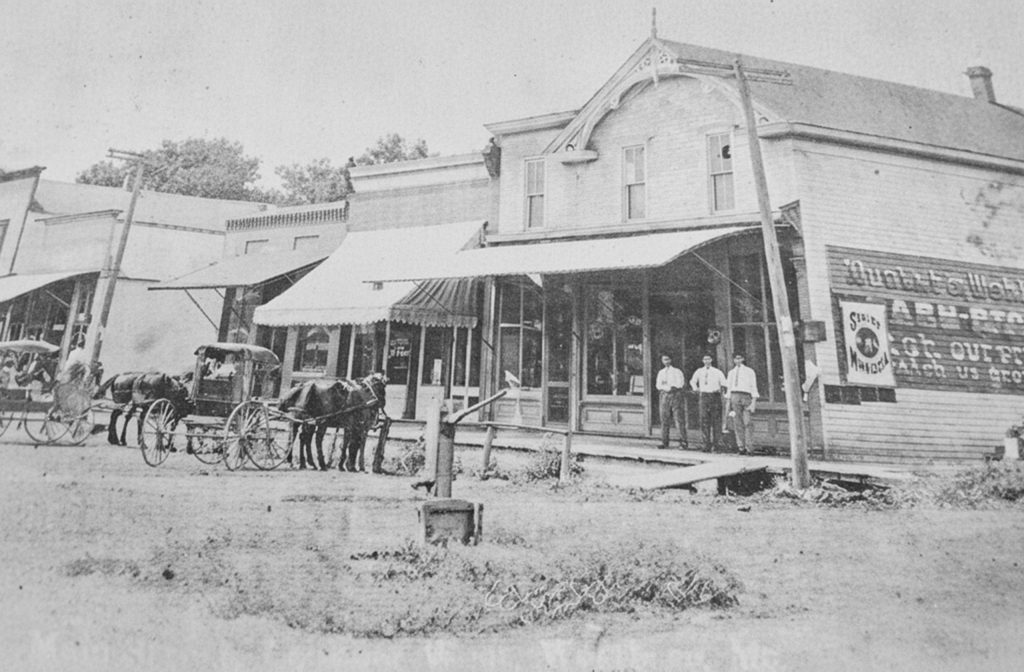
Tucker’s Store was deeply woven into the fabric of the Westboro community in the early 1900s. (Photo submitted by Beverly Clinkingbeard)
The remembrances of Scott Tucker
By Beverly Clinkingbeard
In 1981, Betsy Chapin was teaching the fifth and sixth graders at Westboro Elementary School in Westboro, Missouri. The pupils were given the assignment of asking a senior citizen, their grandparents or a friend, to write an essay of what their school days were like. Those who were asked were in school at a time when essay/story writing and penmanship were a part of their curriculum. As a result, their remembrances were well articulated and the handwriting quite legible or type written. In the coming weeks, their experiences will be shared. Thank you, Betsy, and thank you to the contributors, now deceased, for sharing their yesterday experiences.
Scott Tucker
The A.R. Tucker family moved to Westboro in 1913 from Saline County, Missouri. The family purchased a general store and quickly became the fabric of the Westboro community. Tucker’s Store had most anything a shopper needed. Son, Scott, would join his father at the store, and a sister, Blanche, became Postmistress in 1939 at the Westboro Post Office. In 1919, Scott attended a Mortician’s School of Science in Kansas City and opened Tucker Funeral Home. He also married Martha Scipes. They had attended school together in Clarence, Missouri. Martha had retail experience and took an active part at Tucker’s Store. They had two children, Martha Ann and Robert. This is Scott Tucker’s story.
To Betsy Chapin,
You have asked an almost impossible task for me. I entered school in 1896, in a class of about 30. There were two grades in each room. First through sixth was on the first floor. The high school was on the second floor. The high school was in quite a large room, with two classrooms close by. We were required to carry five subjects through the entire four years: Latin, all four years, math, English, history, and science. In science, we had little equipment. The building was a wood building. It was heated with a coal stove in each room and two in the high school. There was a box close by to hold extra coal. Two large privies were on the back of the school lot – one for the boys and one for the girls.
Everything was done by one man – the teacher. In sports, we had baseball in spring and fall. In winter, we played blackman and tug-o-war by holding hands. Also a game called shinney was played, which was done by each player having a stick and a tin can in the center. Sides were chosen and each side tried to bat the can to the other side.
In winter, both boys and girls wore long underwear and long black stockings. The boys wore overalls and shirts that were homemade. The girls wore dresses. In cold weather, knit mittens were worn by both boys and girls. The boys’ caps had ear flaps and the girls wore knit hoods. The boys wore overcoats and the girls wore cloaks of wool material. Overshoes were quite low, with cloth tops and fastened with buckles. Shoes worn by both sexes were most always button shoes. We went barefoot in the summer. For Sunday, the boys wore knee pants and the girls better dresses, but always the black stockings.
We took our lunch to school in a paper bag and some had a tin bucket. After the evening meal, we had apples and sometimes cookies. We had either biscuits or cornbread for most meals of the day. In summer, they did bake a bread called salt rison. We did have ice cream for special things and cake.
My home had seven rooms, all heated with wood stoves – again, a privy at the back of the house. For a bath, a tub was brought in and placed close to the stove and the water was heated on the same stove. My father was a pharmacist. Mother stayed home with the children. We were a family of three children – one boy and two girls. All are still living. We always had a dog and sometimes a cat. The Fourth of July, Thanksgiving, and Christmas were the celebrated holidays. Christmas we hung up stockings, which were filled with candy, nuts and sometimes an orange. As mentioned, we burned wood and it was my job to see that there was always plenty of wood. We also had a cow and it was my job to do the milking. We had a horse or two and I had to take care of them.
There was an opera house in the town and the man who owned it was quite a friend of my Dad. He saw that we children got to go to the show without paying. There was also the school programs during the year, as well as spelling bees and box suppers. As for toys, we had very few. Some had what they called a hobby horse. We did have tops and marbles.
I hope this is what you wanted.
Sincerely,
Scott Tucker


