


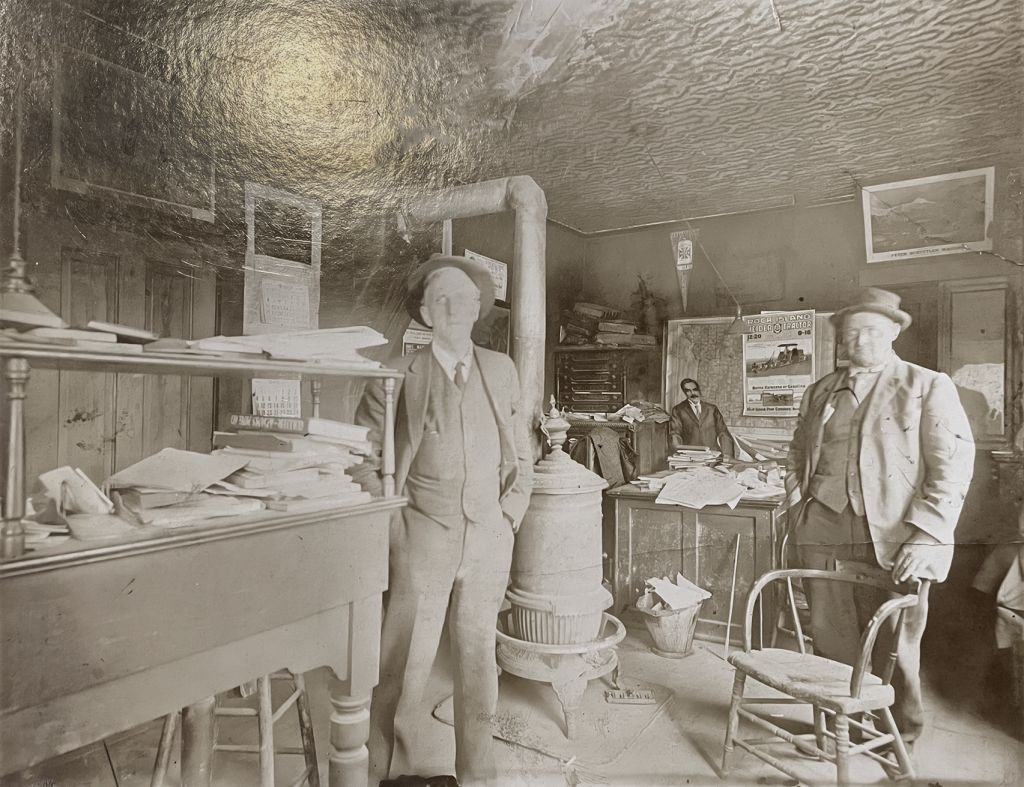
Katherine Rankin Baker’s father was William McKee Rankin and his business was the Caine Rankin Lumberyard and Farm Equipment, seen here. (Of the men pictured, it’s not known which one is her father.)
Submitted by Beverly Clinkingbeard
Katherine Rankin Barker was a teacher and contributor to the Betsy Chapin 1981 Remembrance of Childhood School Days articles that ran the past few months in the Atchison County Mail as “Westboro fifth and sixth grade assignment.” She also wrote about her family and the era of The Great Depression. Children today are not subject to the memories of The Great Depression generation because that generation is deceased. Great-grandparents and grandparents recall their parents saying, “Back during the Depression, we…” and the deprivations and saving ways were told, some in story fashion and others as a directive, such as, “Don’t throw that out! You may need it tomorrow or the next day!” “Waste not, want not.” The Depression began in 1928 and extended through the “dirty thirties.” It altered our national personality just as WWII did. Katherine Rankin Barker gives us a glimpse of that era with her remembrances of before and during The Great Depression. For instance, unemployment in 1933 was an estimated 24.9%; in 1938 it was 19.%. Roughly one-third (200,000) of all American farmers were facing farm foreclosure in 1933.
The following is “Stories Told by Family.” Katherine’s father was William McKee Rankin, a merchant in Tarkio, Missouri. She begins with:
“Papa’s father was in the Civil War on the northern side (Union) and fought in some of the battles. His captain was named McKee, so that is why Papa’s name was William McKee Rankin. Papa’s father brought home with him tuberculosis, from which he was later to die, as well as his two sisters and brother.
“Papa said his father was very agile. He could jump up and clap his feet together three times. He had very blue eyes and would look very severe when he (Papa) had done something wrong. Papa’s family and his mother’s father, John Sloan, came to Missouri and bought land in Bates County. I don’t know why they selected this place unless other relatives were there already. Papa’s people brought black workers with them who lived in a small house on the farm. They taught Papa, a little boy at the time, how to dance to a song called ‘Juba dis and Juba dat and Juba kicked a yellow cat.’ Papa became quite adept at this and performed in Minstrel shows at Tarkio. Papa’s grandfather made him the chair that is still in our family. There are no nails, but wooden pegs.
“One of the first things they did on coming to Missouri was to start a United Presbyterian Church. Papa also told about a very attractive man on a beautiful horse coming one day and the man was very mannerly. Afterwards, they found out it was (Outlaw) Jesse James.
“Papa and his brother, John, started a lumber yard business in Amsterdam, Missouri. His father died in the fall and Papa remembered them making the casket and painting it for the service. It smelled of new paint.
“In the early 1900’s, Papa and his brother, John, came to Tarkio and Papa attended Tarkio College. His mother came with them as his father had died. Papa said she brought all kinds of rose bushes and shrubs in a tub on the train. Papa built their house in Tarkio where they lived and where Mary and I were born.
“Papa had many talents. He could draw interesting pictures for us, especially cowboys, horses and other animals. He also sang and one of his favorites was Old Dan Tucker. He had a lot of acting ability and a chance to join a theatrical group in Kansas City when he went to business school. He could read poetry and stories wonderfully well. He loved politics and one time when ex-president Taft was in Tarkio to speak, Papa brought him around to our home. We all shook his hand. He was very nice and was a very big man. We had other important people in politics that were friends of our folks. Papa was a standby delegate to a National Republican Convention at Chicago and he and Mama attended the National Convention in Kansas City. When Mama was a delegate, Papa had a lot of pride. He didn’t particularly like business, hated anything mechanical, and I never heard him argue with Mama. He always kissed her goodbye before he left for the lumber yard.
“Stories about Mama’s side of the family:
“Her name was Myrtle Wilson Rankin and Mama’s folks were not farmers, but professional people – teachers and business people. Mama’s father was James Wilson and his father was Maxwell Wilson. There were no girls in the family. His mother was Martha Moffett Wilson. They were from South Carolina, then up to Indiana and Illinois. Mom’s mother was Susan Dunnington. The Dunningtons had come to Maryland first. All Moffetts, Strongs and Dunningtons were Revolutionary War soldiers. Mom’s folks were married in Indiana, then came out to Parson, Illinois. This is where Mom was born. Her father had taught at Indiana University, then got into the banking business. David Rankin was also from Illinois and came out to Tarkio. When he started his bank in Tarkio, he had Mom’s father as cashier of the First National Bank. Soon the family came to Tarkio and they built a home looking out on the park.
“Mom’s mother died when she was 44 years old and Mom was only 12 years old. There were three boys, Will, Orval and Charles. Grandfather Wilson had his mother, Martha, come and keep house for them. She brought southern ways of doing things, such as eating rice and cornmeal mush instead of potatoes. When they would leave the door open she would say, “Do you think we are living in the South?” Later, she returned back east.
“Mom went to school in Tarkio and graduated from Tarkio College in 1891 with an A.B. Degree, majoring in music. When Uncle Charlie went to Egypt to be business manager of the United Presbyterian College in Cairo, Egypt, he was married and three boys were born there. Mom went to Assiut, Egypt, to Pressly Memorial Institute where she taught music and English. There were a number of Tarkio College graduates as teachers and missionaries there. In the summer it was very hot and they went north, so she was able to see many different places. At the end of three years, she returned to the USA.
“She had written to Papa while in Egypt and they were married in St. Louis, Missouri, at Uncle Orval’s home. Papa’s mother had died during the interval, so they lived in Papa’s home as Mom’s father had also died in 1903 of cancer.
“Mom was a very small woman with black eyes and brown hair. She wore size three shoes and was not quite five feet tall. She loved people and they loved her. The folks entertained and she belonged to several clubs and was active in church and politics. The only time I ever saw her angry was when a kitchen chair that she had tried to fix, and Papa hadn’t, fell apart. She threw it out the back door.
“She had heart trouble and high blood pressure. Papa helped her a lot and had ‘hired girls’ come help with washing and cleaning until we grew up. Papa and she were a devoted couple and never had any angry words to say to each other. I was blessed by having such loving parents. She always came in to kiss us goodnight. The Depression was hard on her. She hated it that we had such a hard time, but she never complained. She and Papa enjoyed reading and they were anxious that we have music lessons and a college education. We were always in church on Sundays and we always were just family on Sundays.”
The next installment is job hunting in The Depression Days.
(To be continued…)


